11/10/2017

Electrifying Reading & GWR Diversions

Over the weekend of the 16th and 17th of September, the main Great Western lines through Reading were closed to enable testing of the newly erected overhead power lines in readiness for the imminent rolling out of the new Class 800 IEPs, and the not-too-distant Crossrail Elizabeth Line services.

As a result of this, all the (high speed) inter-city services to/from the West country were diverted away from the area taking a scenic trip through the Chilterns.  The diversion saw services from Swindon divert off the main line just before Didcot before running north up to Oxford.  Here, following a brief stop to change crews and pilots, services then ran via the new Chiltern line through Oxford Parkway, Islip and Bicester Village, picking up the Chiltern mainline at Bicester.  Great Western services followed the Chiltern line down to South Ruislip at which point they used the Great Western's single track link, otherwise known as, the New North Main Line (NNML), all the way down to Paddington.  Trains out of London Paddington ran as far as West Ealing before taking the Greenford Branch up to Greenford South Junction before joining the NNML up to South Ruislip, to ease timetabling over the single track section.


My main interest during these diversions was GWR services running over the Chiltern link to Oxford.  Great Western have run services before over the Chiltern line during times of engineering works on the GWR main line, however this was the first time such diversions were taking place after the link through to Oxford had opened completely.  This meant the GWR services no longer had to reverse at Banbury and could shave a considerable amount of extra time off their services.  I have documented below a series of pictures from along the Oxford branch.


GWR 43150 and 43029 pass through Bicester Village station on route to London Paddington.
© Tommy Cooling

GWR 43017 and 43151 pass through Bicester Village station on a diverted service from London Paddington.

The Bicester station on this line before Chiltern took over was called Bicester Town, and was a Great Western Railway station and service on a branch line out from Oxford. The shuttle service though was worked using Class 165/6 DMUs so a GWR HST would still have been out of place, as much then as now!
© Tommy Cooling

GWR 43142 and 43053 (University of Worcester) brings a diverted Great Western Railway service from London Paddington to Carmarthen on the new link off the Chiltern Railways main line onto the "new" Bicester and Oxford branch at Bicester Gavray Junction.
© Tommy Cooling

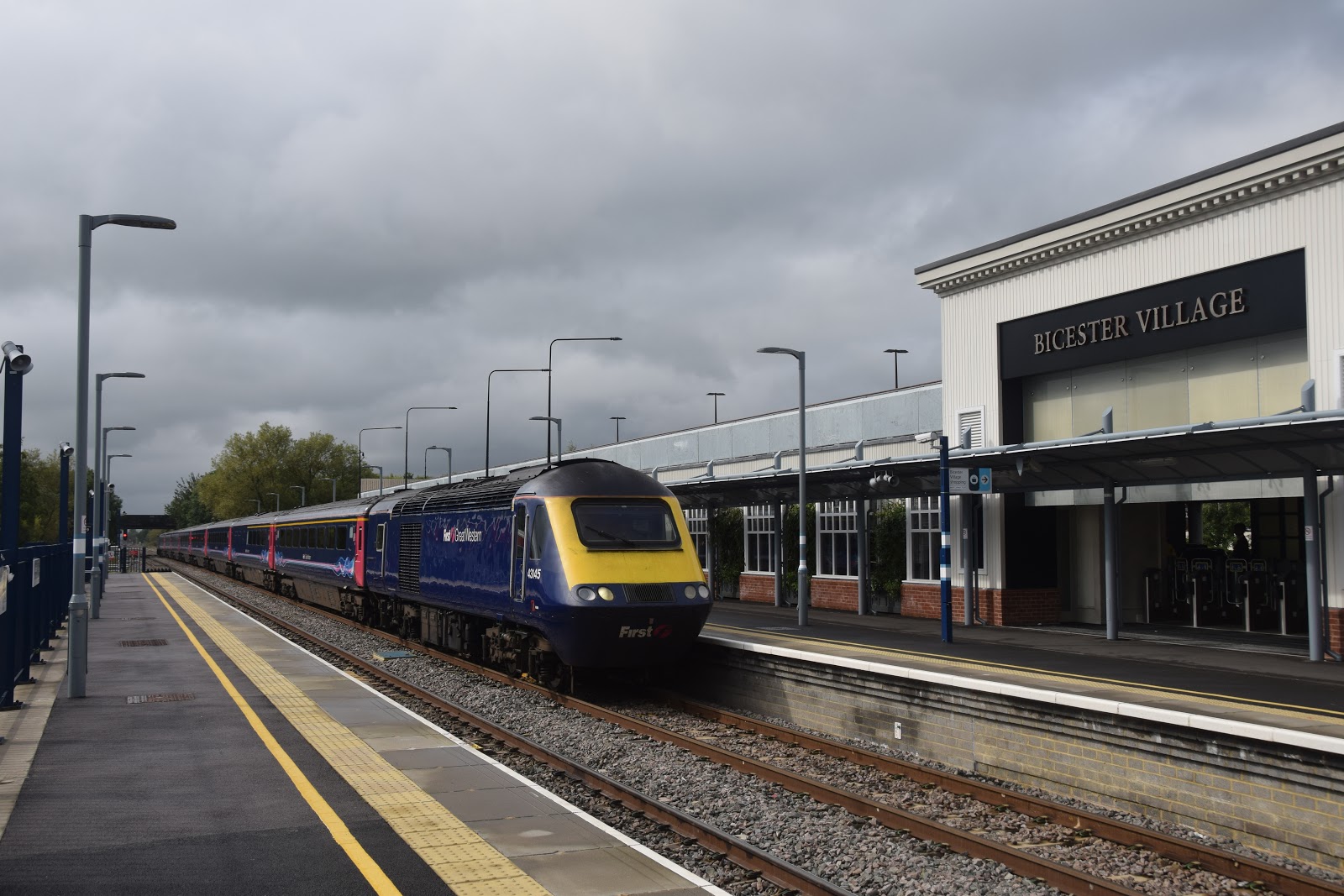
GWR 43145 & 43172 passes through Bicester Village Station on a diverted London Paddington service.
© Tommy Cooling

GWR 43172 (Harry Patch) at Bicester Village.
© Tommy Cooling

GWR 43093 (Old Oak Common) and 43158 pass through Oxford Parkway on a London Paddington to Swansea service.
© Tommy Cooling

GWR 43026 and 43177 speed through Oxford Parkway on a diverted Great Western Railway service to London Paddington.
© Tommy Cooling

GWR 43029 and 43150 bring a service from London Paddington to Swansea through Wolvercote Tunnel, outside Oxford.
© Tommy Cooling


Post by Tommy Cooling
All these images and more can be found on my Flickr page:
Please do not reproduce any of my images without permission

30/09/2017

A 258 change for the better??

Brief history of Route 258
The 258 began life in 1971 as a replacement for the 182 which was withdrawn between Harrow Weald and Watford Junction. The route ran from Harrow-on-the-Hill station to Watford Junction on a PVR of 5MBs from Harrow Weald garage.

In 1978 the route was extended southwards from Harrow to South Harrow, and then rerouted to run via Harrow-on-the-Hill from 1981 replacing the withdrawn route 136.

In 1991 the 258 route contract was awarded to Luton & District and ran from Garston garage. In January 1996 the route was awarded to London Bus Lines from Southall and ran with Plaxton Pointer Darts. A Sunday service was introduced from April 96.

January 1999 the route was won by First CentreWest running from Alperton. Low-floor Trident President (TN) buses were introduced in 2001.

In February 2006, Arriva the Shires won the route and ran it from Garston using eleven new Wrightbus Pulsar Gemini buses.

During the early part of summer 2017 it was announced that RATP London Sovereign had won the new 258 contract and would use E400 ADEs displaced by Metroline's takings of the 120 and 222. By mid-summer it became apparent that Sovereign would be capable of taking over the route much earlier than the original contract date. Following agreements between Sovereign, Arriva and TfL is was agreed that the route would change operators on 30-Sept 2017 instead of February 2018.


First's operation of the route was hampered by long garage runs to/from Alperton and reliability suffered badly. When Arriva took over it was hoped that the reliability would improve and for a time it did. Overtime however the reliability fell, hampered by unpredictable traffic flows in and around Watford. Whenever Watford FC played at home, the entire route seemed to disappear! The long garage journeys to and from Garston have also since played a part in Arriva's poor reliability. The allocation has often gone walkabout too in recent years with as many as five single deck buses on the route at one time! At the very end the fleet of DWs at Garston have been all but replaced by older VLWs displaced by LTs from Ash Grove, with only DWs 145, 190 & 191 still in the fleet.

As a very regular user of the 258, the service under First was not very good, and had only gone down hill since. London Sovereign can hardly do a worse job, or can they?! The only thing I'm going to miss is the complete randomness of the 258s allocation.

Arriva's 258

[Now withdrawn] DWL94, then 3725, climbs Roxeth Hill in December 2015
© Tommy Cooling

VLA175 is a typical example of daily allocation of the 258 and is seen in Harrow in August 2016
© Tommy Cooling

The official 258 allocation comprised eleven Pulsar Gemini DWs as shown by DW141 in Harrow in August 2016
Of the original batch, only DW145 has survived but it remains to be seen if it'll survive the 258s departure.
© Tommy Cooling

A fine example of the 258 at the end with a broken down PDL119 being overtaken by VLW156 in Harrow during July 2017
VLW156 is one of 15 that have moved from Ash Grove to Garston since January 2016.
© Tommy Cooling

London Sovereign Preparation

ADE40415 beds in at its new home in Edgware with a run out on the 619 in Harrow in early September 2017
E400 ADEs made spare from the 120 and 222 will take up the new allocation of the 258 when it passes over to Sovereign.
© Tommy Cooling

 London Sovereign's 258
 
ADE40411 pulls out of South Harrow Bus Station on the first morning of RATP operation  30/09/17
© Tommy Cooling

ADE40418 arrives in South Harrow Station on the first morning of RATP operation  30/09/17
© Tommy Cooling
 
ADE40418 in Harrow Town Centre heads towards South Harrow  03/10/17
© Tommy Cooling

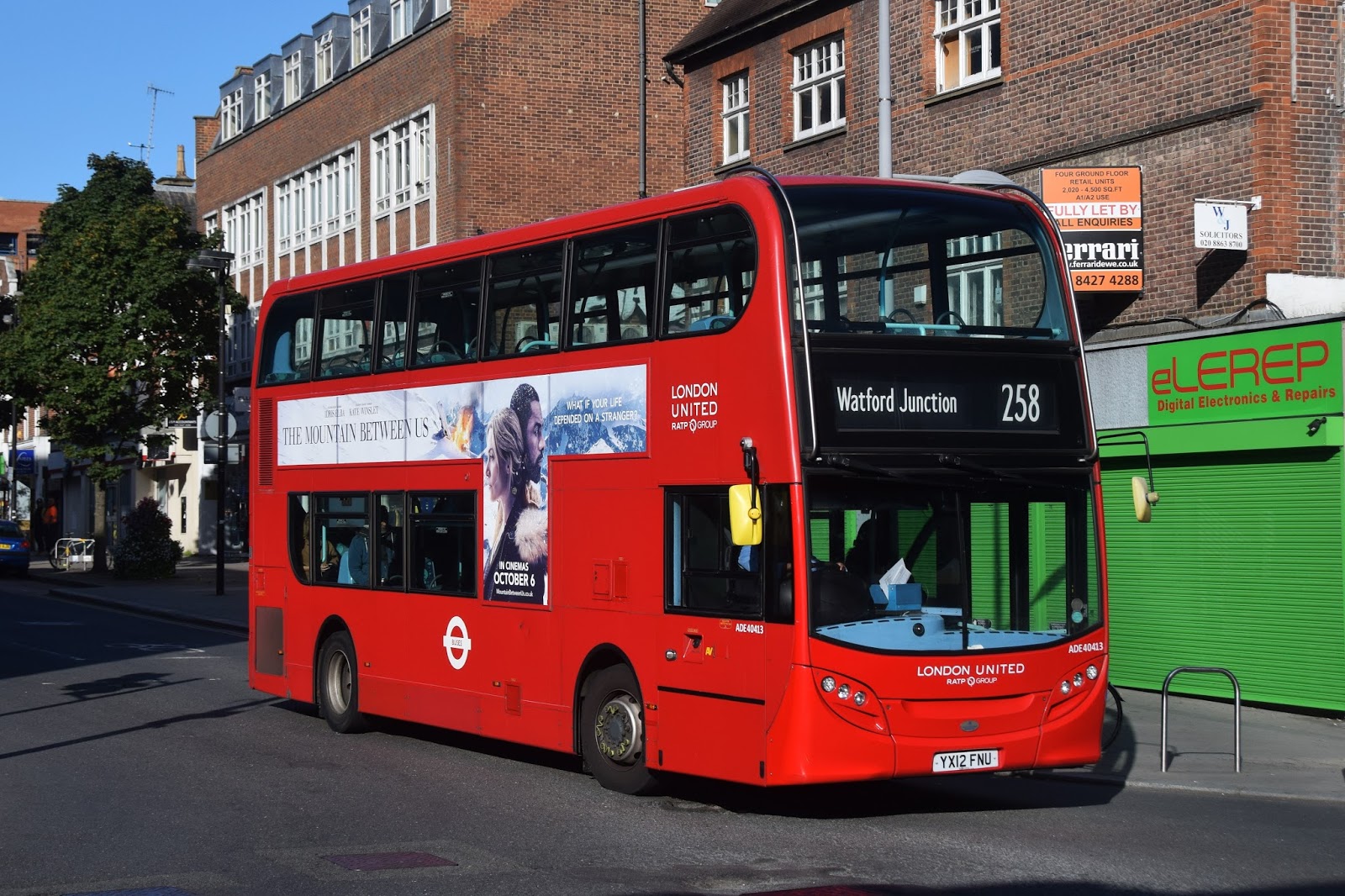
ADE40413 in Harrow Town Centre heads towards Watford Junction  03/10/17
© Tommy Cooling
 
ADE40434 picks up outside Watford Junction Station ready to form a service to South Harrow
© Tommy Cooling


ADE40409 waits on stand for its correct departure time in Watford
© Tommy Cooling
 
Post by Tommy Cooling
All these images and more can be found on my Flickr page:
Please do not reproduce any of my images without permission

20/09/2017

Picture Archive Post 63

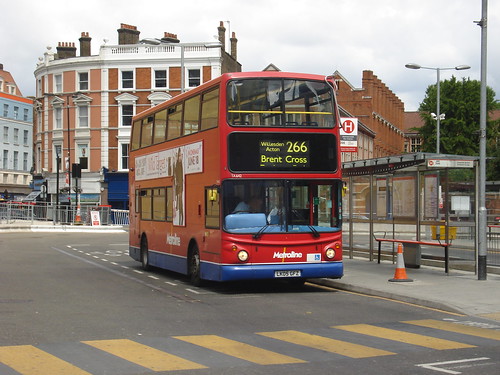
Metroline TA642 on Route 266, Hammersmith, 19/06/2010
Metroline TA642 on Route 266, Hammersmith, 19/06/2010 (© Aubrey)

Route 266 was introduced as the bus replacement of former trolleybus route 666. Running between Edgware and Hammersmith, the route ran as current 266 to Cricklewood, then as current 32 to Edgware. Introduced as part of Stage 13 of trolleybus replacement on 3rd January 1962, new Routemasters were introduced from Stonebridge Garage (SE) and Cricklewood Garage (W). A Willesden Garage (AC) allocation was added in September 1968, after Route 260A was withdrawn. In June 1970, the route was withdrawn between Edgware and Colindale (peak hours), West Hendon (weekdays) and Cricklewood Garage (weekends). June 1972 saw Hammersmith Riverside (R) gain an allocation to cover for the 255 withdrawal. 255 itself was a former trolleybus route of 655. In January 1976, Brent Cross Shopping Centre opened and Route 266 was diverted to the shopping centre on Monday-Saturday except late evenings. From October 1978, some journeys were extended in Monday-Friday peak hours via Graheme Park to Mill Hill Broadway on Monday-Friday peak hours. April 1979 saw the allocation of crewed Daimler Fleetlines (DM) on Sundays from SE. In 1980, the DMs were replaced by MCW Metrobuses (M), still crewed. 1981 saw the peak hour extensions to Mill Hill be withdrawn, and SE be closed. The SE allocation was replaced by a split Willesden and Cricklewood allocation. 1982-1985 saw the allocation solely be dealt with by W. 1985 saw the conversion of the route to OPO, with Ms initially introduced crewed before November. 

Under sectorisation, the route came under Metroline. 1995 saw the whole shopping hours service extended to Brent Cross. June 1998 saw the service partly, then completely in December 1998 go to Cricklewood Garage. September 2000 saw the route move to Harlesden (HR), and convert to Volvo Olympians ex-16/52. 26th July 2003 saw the route be fully extended (day and later night) to Brent Cross Shopping Centre, as the bus station later became known as an interchange. 17th April 2004 saw the N266 become renumbered into 266, based at W. The day route moved to W on 21st May 2005, as the route was converted to low-floor with Tridents. On 22nd May 2012, the 266 was won by First Centrewest using Volvo B9TL/Wright Eclipse Gemini 2s, from their new garage at Atlas Road (AS), a base to replace the temporarily closed part of Westbourne Park (X) due to Crossrail work. 22nd June 2013 saw the contract novate to Tower Transit, as they bought out that part of First Centrewest. As AS closed on 1st July 2017, the route moved to X for 28 days, as then the route returned to Metroline on 29th July 2017 (for 2.5 years).

Alexander-Dennis Trident/ALX400 TA642 started out in 2005 as a bus for Cricklewood, as part of the low-floor conversion of Route 266. Initially based at Cricklewood, it moved to Brentford (AH) to replace Tridents which were on lease for the 237. Once those buses were replaced by TPs (Trident/Presidents), the bus moved back to Cricklewood. Ironically, on the first day of 266 back with Metroline, TA642 was back on the route!

Return of the Trident
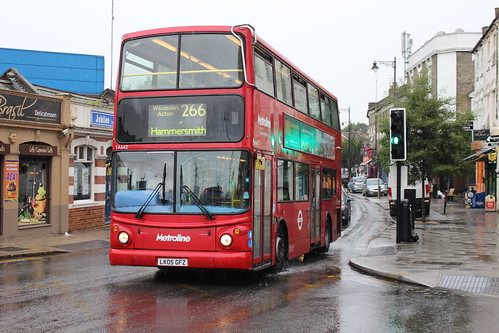
It was like nothing had changed, as on 29th July 2017, TA642 is seen back on its old haunts.
(© Aubrey)