Somehow, we've gotten to our sixth year of blogging and as traditionally so, we put a post out on the birthday of the blog. This year, the blog members are going to say what our favourite bus type are, and why.
Aubrey:
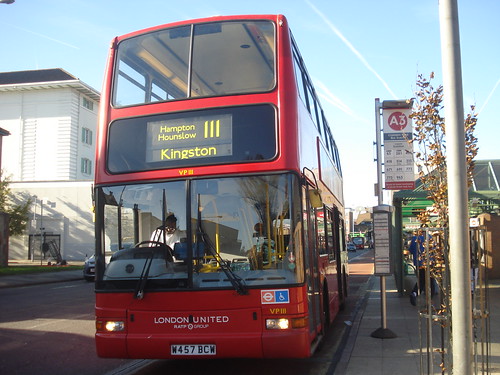
London United VP111 on Route 111, Kingston Cromwell Road, 2013
(© Aubrey Morandarte)
Firstly, it's of course the sod whom made the blog in the first place. As we are a bunch of similarly aged sods, we'll most likely pick buses we grew up with. For my bunch, I've chosen the Euro II Volvo B7TL, with the Plaxton President body. From 2000 to 2013, the Volvo B7TL was the mainstay for Hounslow based double decker bus routes. These Euro 2 examples were ordered for the 120/H32 (the VAs were ordered for the 111).
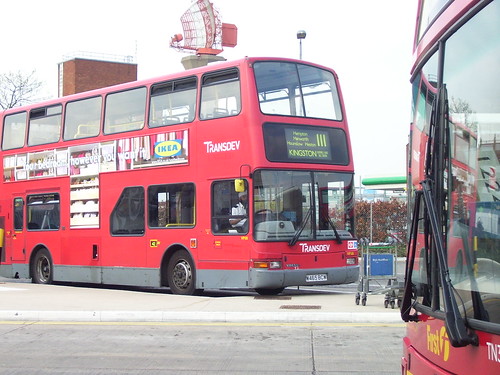
VP118 back in 2007 at Heathrow Central Bus Station on Route 111
(© Aubrey Morandarte)
These buses were the then new buses that were on the 111 at the time that I used to go to Heathrow to spot planes. As these buses were the buses which partly helped me get into buses, this is why they are good. They are also powerful enough when required, and the President body in itself was decent. The interior was basic, but good nevertheless. Without these buses, I wouldn't be into buses. Most first generation low floor deckers, in my opinion, were pretty good anyway, but as these buses were the ones that got me into buses, they have to be the favourite.
Lewis:
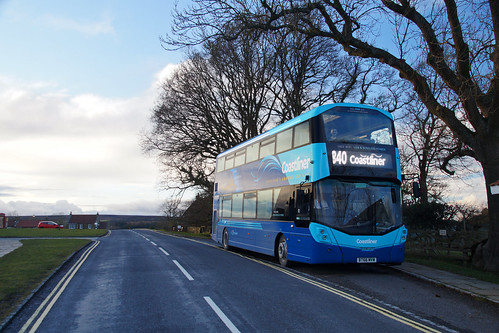
Yorkshire Coastliner 3637 at Goathland on a Whitby 840 service.
(© Lewis Nagle)
Next it's the sod who used to live in London but now studies up north. Having up till now mainly been on commercial bus services in the Home Counties (see my previous posts on services in Bucks & Berks) and then to the south of the capital in Crawley & Brighton, I naturally made it my task to go on more exploratory journeys and where better to start with the nationally famous Transdev Blazefield empire across the north? Last summer I was able to try out the Coastliner 843 to Scarborough, a tremendous high-pace ride through the Yorkshire countryside as well as the famous #the36, the WitchWay X43 and what is now the Aireline 60. Transdev pride themselves in high-quality services with a classy bus spec, friendly drivers and fantastic routes.
The latest in my adventures across the north saw me finally doing the best of the Yorkshire Coastliner services: the 840 to Whitby. A single Transdev DayTripperPlus is all one needs to bus it from Manchester to Whitby although it's a long journey, around the 5 hour mark.
The 840 is well worth it though, a superb scenic journey starting in Leeds and ploughing through the countryside to Tadcaster (with its bridge now reinstated since last year), the beautiful city of York, Malton and then out to Pickering, Thornton-le-Dale and Whitby. It's worth noting that on my journey, because it was a Sunday, the Leeds-Malton bit was a connecting 843. The scenery through the Yorkshire Moors is nothing short of stunning and the route even has to negotiate 25% inclines around Goathland, where the above picture was taken.
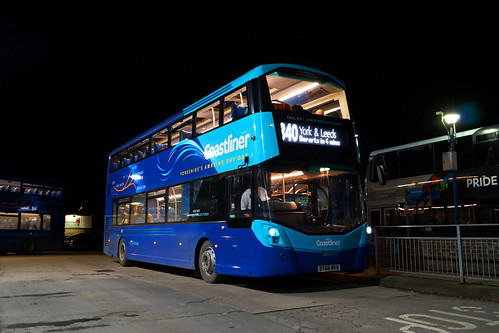
The same bus as above, now returning to York & Leeds on a small break at Malton.
Note the countdown on the destination display; a superb feature which I'm hoping we'll see more of in the future.
(© Lewis Nagle)
A little something about the buses: they're Volvo B5TL based Wright Gemini 3 double deckers new last December. Whatever your opinion is on the new face styling, it certainly suits the two-tone blue livery here. Inside the blue theme continues, with standard seating downstairs and high-backed coach-style seats upstairs. Tables, USB charging points and free wi-fi are available. The vehicles are even double-glazed so all of my journeys were remarkably toasty! The 5-litre Volvo engine copes fantastically on flats and downhill, regularly hitting its speed limiter at 56 mph, however as soon as you're going uphill it's much less happy. The bodywork by Wright has a real classy finish to it - and is very quiet on the move - but as ever rattles and squeaks still present a problem. It's an insult to the hours of thought gone into designing this spec for the bus to then rattle.
I don't wish to end on a negative note so I won't; I've been very happy working alongside the blog team for the last 6 years and hoping to many more! Lots of exciting things coming in 2018 too...
Jacek:
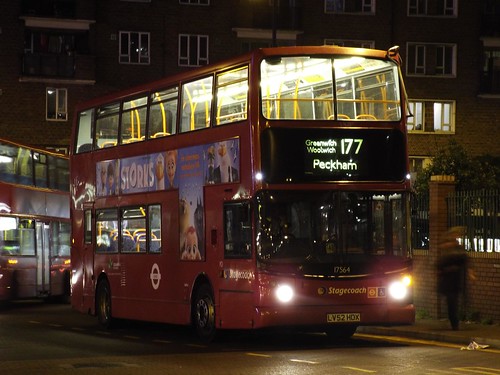
17564 on Route 177
(© Jacek Herominski)
Well, this is an obvious one. My favourite buses are what I grew up with. Even if one company ordered the same type back then, every batch always had its own character, its own sound, as a result of the varied specs everyone had. Nowadays I like all the first gen low floor deckers equally, but back then I was a Trident person. Which is why I've chosen my two favourite batches of Tridents.
The 52 plate is a Euro3 3-speed one, which were always my favourite ones for their musical Voith and the amount they thrashed up hills. Second place is represented by that Y reg. These Euro2 ZFs replaced a batch I didn't like, and came after my 52reg were cascaded away so basically took their place in my heart. That sounded overly romantic. Oh well, it is Valentine's Day soon.... (No)
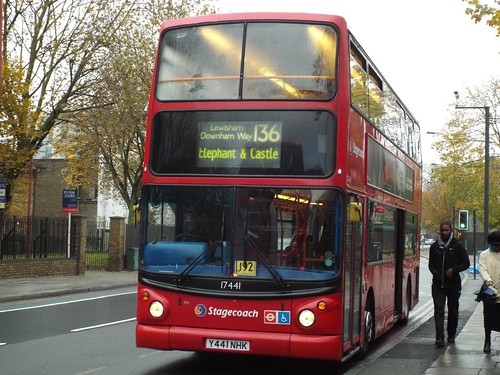
17441 on Route 136
(© Jacek Herominski)
Omar:
Now, the resident crazy traveller. I'm the sort of person that loves a bit of everything, be it the cityscapes offered by routes down in London, the sea views of the Brighton & Hove Coasters or the weaving in and out of hills on West Yorkshire bus routes. In short, I love the variety you get from travelling on buses. Now, some buses suit this sort of variety better than others, ranging from being completely adaptable to being horrible to travel on! My personal favourite is the Mercedes-Benz O405N2, yet I don't actually have any photos of them. However, my second option isn't really all too bad, and that's the Wright Renown-bodied Volvo B10BLE, coupled to a ZF box of course.
A 5-speed ZF box coupled to Volvo's throaty 9.6 litre D10A engine churning out 245bhp not only sits happy in cities and calmer environments. It also provides a reliable and powerful base for country routes such as the Mainline M4, which was run by a mix of B7RLEs and B10BLEs when I rode it. The ride quality is usually very smooth and comfortable, and the bodywork is incredibly sturdy and largely rattle-free, a far cry from the current range of Wrightbus products. Sadly, a large number of them saw the end of the line before 2016 as the DDA rules kicked in to withdraw all non-compliant single decks from service. The ones that are DDA compliant, as well as the ones that have received modifications to become compliant, still soldier on to this day, some being as old as 18 years old this year! Since their introduction in 1997, as a low floor version of the already popular B10B, they have become the backbone of many towns and cities, and helped to kick-start the low-floor revolution, all while being generally reliable and loved by drivers, engineers, enthusiasts and passengers alike.
Alisha:
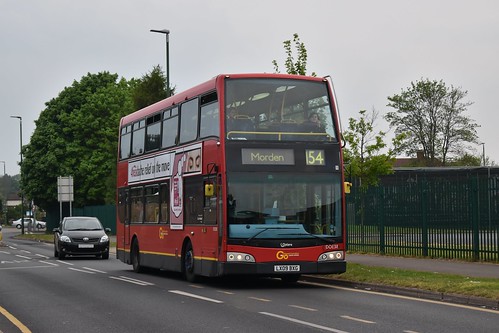
DOE38 passing through in Roundshaw in May 2017, sporting the iconic, sadly now lost livery
(© Alisha Juszczyk)
My favourite London bus type has got to be the Olympus - be it East Lancs, Darwen or Optare - doesn't matter. A top class double-decker body, and no wonder also a popular choice for tour buses thanks to their giant front glass upstairs. Out of all the chassis available for it, good old Dennis Trident 2 proves the ultimate fit. Shame only 55 ever ended up in London - the DOE class under Go-Ahead, and the singleton EO1 under CT+ which has since left the city and moved north. All of which had comfortable seating provided, alongside with spacious layout, and subdued lighting that creates a relaxing atmosphere.
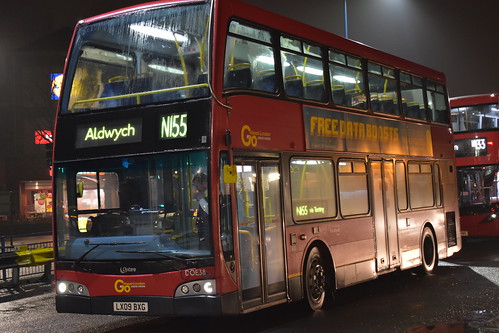
The same DOE standing at Morden about to start its journey on N155, a great route to test their abilities - taken February 2017
(© Alisha Juszczyk)
London United VP111 on Route 111, Kingston Cromwell Road, 2013
(© Aubrey Morandarte)
Firstly, it's of course the sod whom made the blog in the first place. As we are a bunch of similarly aged sods, we'll most likely pick buses we grew up with. For my bunch, I've chosen the Euro II Volvo B7TL, with the Plaxton President body. From 2000 to 2013, the Volvo B7TL was the mainstay for Hounslow based double decker bus routes. These Euro 2 examples were ordered for the 120/H32 (the VAs were ordered for the 111).
VP118 back in 2007 at Heathrow Central Bus Station on Route 111
(© Aubrey Morandarte)
These buses were the then new buses that were on the 111 at the time that I used to go to Heathrow to spot planes. As these buses were the buses which partly helped me get into buses, this is why they are good. They are also powerful enough when required, and the President body in itself was decent. The interior was basic, but good nevertheless. Without these buses, I wouldn't be into buses. Most first generation low floor deckers, in my opinion, were pretty good anyway, but as these buses were the ones that got me into buses, they have to be the favourite.
Lewis:
Yorkshire Coastliner 3637 at Goathland on a Whitby 840 service.
(© Lewis Nagle)
Next it's the sod who used to live in London but now studies up north. Having up till now mainly been on commercial bus services in the Home Counties (see my previous posts on services in Bucks & Berks) and then to the south of the capital in Crawley & Brighton, I naturally made it my task to go on more exploratory journeys and where better to start with the nationally famous Transdev Blazefield empire across the north? Last summer I was able to try out the Coastliner 843 to Scarborough, a tremendous high-pace ride through the Yorkshire countryside as well as the famous #the36, the WitchWay X43 and what is now the Aireline 60. Transdev pride themselves in high-quality services with a classy bus spec, friendly drivers and fantastic routes.
The latest in my adventures across the north saw me finally doing the best of the Yorkshire Coastliner services: the 840 to Whitby. A single Transdev DayTripperPlus is all one needs to bus it from Manchester to Whitby although it's a long journey, around the 5 hour mark.
The 840 is well worth it though, a superb scenic journey starting in Leeds and ploughing through the countryside to Tadcaster (with its bridge now reinstated since last year), the beautiful city of York, Malton and then out to Pickering, Thornton-le-Dale and Whitby. It's worth noting that on my journey, because it was a Sunday, the Leeds-Malton bit was a connecting 843. The scenery through the Yorkshire Moors is nothing short of stunning and the route even has to negotiate 25% inclines around Goathland, where the above picture was taken.
The same bus as above, now returning to York & Leeds on a small break at Malton.
Note the countdown on the destination display; a superb feature which I'm hoping we'll see more of in the future.
(© Lewis Nagle)
A little something about the buses: they're Volvo B5TL based Wright Gemini 3 double deckers new last December. Whatever your opinion is on the new face styling, it certainly suits the two-tone blue livery here. Inside the blue theme continues, with standard seating downstairs and high-backed coach-style seats upstairs. Tables, USB charging points and free wi-fi are available. The vehicles are even double-glazed so all of my journeys were remarkably toasty! The 5-litre Volvo engine copes fantastically on flats and downhill, regularly hitting its speed limiter at 56 mph, however as soon as you're going uphill it's much less happy. The bodywork by Wright has a real classy finish to it - and is very quiet on the move - but as ever rattles and squeaks still present a problem. It's an insult to the hours of thought gone into designing this spec for the bus to then rattle.
I don't wish to end on a negative note so I won't; I've been very happy working alongside the blog team for the last 6 years and hoping to many more! Lots of exciting things coming in 2018 too...
Jacek:
17564 on Route 177
(© Jacek Herominski)
Well, this is an obvious one. My favourite buses are what I grew up with. Even if one company ordered the same type back then, every batch always had its own character, its own sound, as a result of the varied specs everyone had. Nowadays I like all the first gen low floor deckers equally, but back then I was a Trident person. Which is why I've chosen my two favourite batches of Tridents.
The 52 plate is a Euro3 3-speed one, which were always my favourite ones for their musical Voith and the amount they thrashed up hills. Second place is represented by that Y reg. These Euro2 ZFs replaced a batch I didn't like, and came after my 52reg were cascaded away so basically took their place in my heart. That sounded overly romantic. Oh well, it is Valentine's Day soon.... (No)
17441 on Route 136
(© Jacek Herominski)
Omar:
 |
| First Aberdeen 62166/Y631RSA | Route 3G | Mastrick Terminus | 14/02/2017 © Mohammad-Omar Diab El-Arab |
Now, the resident crazy traveller. I'm the sort of person that loves a bit of everything, be it the cityscapes offered by routes down in London, the sea views of the Brighton & Hove Coasters or the weaving in and out of hills on West Yorkshire bus routes. In short, I love the variety you get from travelling on buses. Now, some buses suit this sort of variety better than others, ranging from being completely adaptable to being horrible to travel on! My personal favourite is the Mercedes-Benz O405N2, yet I don't actually have any photos of them. However, my second option isn't really all too bad, and that's the Wright Renown-bodied Volvo B10BLE, coupled to a ZF box of course.
 |
| Transdev Burnley & Pendle 1057/Y157HRN | Route M4 | Colne, Market Street © Mohammad-Omar Diab El-Arab |
Alisha:
DOE38 passing through in Roundshaw in May 2017, sporting the iconic, sadly now lost livery
(© Alisha Juszczyk)
My favourite London bus type has got to be the Olympus - be it East Lancs, Darwen or Optare - doesn't matter. A top class double-decker body, and no wonder also a popular choice for tour buses thanks to their giant front glass upstairs. Out of all the chassis available for it, good old Dennis Trident 2 proves the ultimate fit. Shame only 55 ever ended up in London - the DOE class under Go-Ahead, and the singleton EO1 under CT+ which has since left the city and moved north. All of which had comfortable seating provided, alongside with spacious layout, and subdued lighting that creates a relaxing atmosphere.
The same DOE standing at Morden about to start its journey on N155, a great route to test their abilities - taken February 2017
(© Alisha Juszczyk)
The low blind-box provides an acceptable means to rest your legs, and even something as trivial as the side windows that slant down to maximise the view out - it all shows what a great bodywork design this one is. Another clever feature I've always liked is the curved windshield on the upper deck which yields the following effect - at night you don't get any unnecessary reflections of the bus' interior when facing forward, unless you look up that is - and being able to inspect what's behind you without having to physically turn around is very handy. They are also mechanically sound, fast buses, and fortunately with kickdown enabled to make scaling of the numerous hills on their usual routes efficient. Their scarcity makes them even more precious and valued!
Tommy:
The bus type I had planned to talk about was the Plaxton President bodied bus, the type being local to me in Harrow since the early 2000s, TP/Ls then latterly VP/Ls at Harrow Weald with a batch of 17 still in use (what will be the last VPs left in the Metroline fleet, VP612-628!). This would have been the perfect excuse to repeat my picture of TP446 from the 'Fifth Year' blog post, however, the President type has already been covered so to save repetition, I thought I'd do this piece about my next favourite bus type.
Now this is the ALX400 bodied vehicle that in London can be found with either an AD Trident or Volvo B7TL engine, my preference being the Trident version but both types I rate equally. I cannot quite put my finger on why I rate ALX400s as much as I do bar it being an all-round pleasant bus. The past three years have seen me use both the Trident and Volvo examples in North West London on a fairly regular basis which has cemented these vehicles' place on my preference list. But, the ALX400 has also been mentioned in this post, and for the same reasons as above I do not feel it worth while that I discuss the same vehicle twice.
So, I shall move onto my next choice, and it's onto a bus that I have not really thought much about, but it's one that has dominated the London scene, but like the other types mentioned above, is fast becoming an endangered species in London. The type is the Plaxton Pointer Dennis Dart SLF. In its prime, the Dennis Dart was one of the most popular single deck buses from the late 1990s through to the mid 2000s. They were just as popular as the Enviro 200 (and MMC "upgrade") has become since.
For me the Dart is aesthetically pleasing on the eye, and always had seats with generous leg room and decent amounts of seat padding. I found the Darts rattled less than the E200s which replaced them meaning the Darts' fabulously whiny engine could be easily heard! The lack of interior refurbishment in later years have also given the Darts a good nostalgia feel too, though that is not to everyone's taste!
For me the Dart is aesthetically pleasing on the eye, and always had seats with generous leg room and decent amounts of seat padding. I found the Darts rattled less than the E200s which replaced them meaning the Darts' fabulously whiny engine could be easily heard! The lack of interior refurbishment in later years have also given the Darts a good nostalgia feel too, though that is not to everyone's taste!
 |
| London Sovereign DPS636 and Metroline DP1012 in Harrow. March 2017 © Tommy Cooling https://www.flickr.com/photos/127662272@N07/33241614882/in/album-72157677403851741/ |
When I think of a proper single deck bus, there aren't many types that come to mind, but it is the Dart that comes to mind first. My exposure to Darts has been nowhere near that to the President or ALX400, but enough for me to rate it as high as third on my list. The majority of my exposure had been the 02 plated London Sovereign Darts at Harrow (SO) on the H9/10. Latterly I got very well acquainted with the Armchair imports at West Perivale, DP1009-1013, that made numerous appearances on the 395 in 2016 and 2017 after the E6 moved garages from West Perivale to Greenford. Arriva Garston also has a small fleet of Darts (PDLs) that have transferred in from other London garages. These have made very rare visits to the 258 and 340, with many other outings on the Harrow circular routes H18/19.
 |
| Arriva London PDL117 in Harrow. February 2016 © Tommy Cooling https://www.flickr.com/photos/127662272@N07/24674218834/in/album-72157665994971606/ |
There are more Darts still kicking around in London than the President class (and many many more with provincial operators), but these will all sadly be bowing out of service within the next year or so if not before when London's new ULEZ emission zones comes into effect.