Showing posts with label Post by Tommy Cooling. Show all posts

22/05/2019

Great West Abellio

On 6th April 2019, Routes 207 and N207 transferred from Metroline West to Abellio London West, giving Abellio a very large stronghold in West London. Both routes will eventually be based in the upcoming permanent Southall Bus Garage in the Great Western Industrial Park, but in the meantime, are based in the former Wings Buses base at Hayes.

Abellio London 2005 on Route 207, White City Bus Station
2005, one of the few new buses ordered for the 207, starts the journey on the first day to Hayes By-Pass. Most of the allocation is compromised of existing classic and MMC Enviro 400s made spare by a reduction on Route 415, as well as the complete withdrawal of Route C2.
© Aubrey Morandarte

The gain of the 207/N207 offsets the loss of Route C2 to the Central London bus cuts, and along the 211 loss, offsets the 24 and 27 tender gains. The relatively small base of Hayes that Abellio has means that they had to shuffle a few routes to accommodate the 207/N207. Routes 195 and U5 moved to Fulwell (TF). Routes U7 and part of H28 moved to the temporary Southall (AB).

Abellio 9534 beside Westfield White City on Route 207 towards Hayes By-Pass.
 Abellio's 9534 was a Battersea (QB) C2 bus, transferred after the withdrawal of the route.
© Tommy Cooling
Other buses which were not affected by the C2 withdrawal also made their way to Hayes from their eastern counterparts, with some Enviro 400H MMCs from the 415, as LTs replaced part of the allocation for the route. Also, other non-C2 buses were also transferred to the route from QB, albeit temporarily.

Abellio London 2467 on Route 207, Ealing Broadway
2467 from the batch intended for the 49 was transferred over to Southall for a few days from the initial contract change. This bus is now back at QB for the 49.
© Aubrey Morandarte

Abellio 2532 in Ealing Common on Route 207 towards White City.
This is one of three different E400 MMC batches that can appear on the route, this batch having transferred from the 415.
© Tommy Cooling

Abellio's MMC batches from 2015, 2017 and 2019 all appear in this one view, and any of these vehicles can be allocated to the routes. Note how the rear of the body type has changed between the 2015 model and the latest 2019 version.
© Tommy Cooling
Although the 207 now shares the 427 allocation, it is infrequent for the 427 branded buses to stray onto the 207/N207, although this has happened in the past as the N207 mainly draws its allocation from the 427 due to the Central London Ultra Low Emission Zone (ULEZ) and that the 427 is the allocated hybrid route out of WS.

Two classic E400s pass close to Ealing Common Station.
© Tommy Cooling
Abellio London 2004 on Route N207, Oxford Street
2004 heads along Oxford Street close to the end of its journey to Holborn.
© Aubrey Morandarte

The N207 was also converted from diesel operation under Metroline West to full Euro VI hybrid operation under Abellio to comply with the Central London ULEZ. It was one convenient sweep to help one of the last few diesel night routes within Central London to convert to hybrid. Other routes that were also still diesel were converted to hybrid through re-allocation of garage.

Abellio London 2401 on Route N207, Tottenham Court Road
2401 is an outlier to the rest of the decker fleet transferred for the 207, as it was not refurbished at all since introduction on the 188. It was transferred from WL to QB at some point, and since went to AB (Southall) for the E1 for a week prior to the 207 gain. It is seen on the N207, starting a journey to Uxbridge.
© Aubrey Morandarte

Abellio London 2532 on Route N207, Oxford Circus
2532 on Oxford Street on the first night of Abellio on the N207
© Aubrey Morandarte

The N207 is the first Abellio London West night service, with the closest prior being the early morning airport journeys on the 350 and 490. As with usual with current TfL policy, the night route has had an element of reduction, with the last few journeys being cut back or withdrawn. The route retains its half and half approach to the western termini, with Hayes By-Pass alternating with Uxbridge between buses.

Unlike the rest of the Uxbridge Road corridor, the 607 retained its operator and new Volvo B5LH/MCV EvoSeti buses were ordered for the route, although due to circumstances regarding electric buses and the Central London ULEZ, not all of the new buses are currently on the route.

Metroline VW1820 beside Westfield White City on Route 607 towards Uxbridge.
A number of these former 427 then 207 VWs continue to ply their trade along the Uxbridge Road, now on the 607. Their time is limited like the route. The remainder of the 607s new VMH allocation can be found on the 43 and 134 because of the Central London ULEZ. They will all be united at Greenford on the route once Metroline's electric buses arrive during summer 2019.
© Tommy Cooling

The blinds in these former Hayes 427 VWs have not been altered since the introduction of these vehicles by First London in 2010, at a time before the 207 and 607 routes were extended to serve the Westfield White City bus station. When these VWs were reused on the 207 after Metroline lost the 427 in 2017, a dayglo "White City" was added for the 207.  These vehicles have been reused again on the Uxbridge Road for the 607 this time, and a clever bit of coding was to also reuse the 207s dayglo White City as a temporary measure until the remained of the 607s VMHs are released.

When the blinds were order for these former First London Hayes VNs for the 427, a conjoined Hayes-Greenford set was designed to give the engineers flexibility if they wished to swap buses. The 607 was not at either garage at the time and was never planned to be moved to either so its inclusion on this [still original First London] blind was a chance encounter as the blind order was hurried and the base for the blinds was taken from an older version from First's Acton Tram depot blinds.
© Tommy Cooling

Metroline VMH2591 showcases the 607s official allocation in Ealing Common, sporting an appropriate yet traditional blue "limited stop" bus blind to distinguish the route from the slower 207 and 427 counterparts. This is still the only TfL route which has blue on white blinds.
© Tommy Cooling

Up to 13 VWs at Greenford can still be found on the 607; VW1818 is one of those seen nearby to Ealing Common Station.
© Tommy Cooling

This significant tender has notably shifted a lot of work to Abellio London West. The sector started out as Tellings Golden-Miller, with not a large amount changing under Travel London duress. Abellio has managed to grow this sector from a relatively medium-scale operation to a large scale operation including trunk routes which were the stronghold of Metroline West. With the new garage in Southall (GW) replacing both WS and AB, this is clearly a time of growth for the company. Adding the gains of Routes 24, 27, 267, E10 and E11 to the repertoire, as well as the retention of most of their work shows a period of growth for this operator.

Post by Aubrey Morandarte and Tommy Cooling

All rights reserved © WLTMTB 2019

03/04/2019

Moving Parliament

These services feel like a side-note in the vast essay that is the UK rail network, but all the same their importance is on equal or greater terms, and historically even more so.  They are rarely seen, usually connecting unusual stations, often running at inconvenient times and likely to be carrying no more than one man and his dog, on a good day; this of course is reference to the "Parliament" or "ghost" trains.  The Parliament service is a long-standing principle of running, sometimes as little as one train a week, and in only one direction, over sections of the railway network that would otherwise be closed.

The Parliament trains have proved a useful tactic to employ when the costs of a formal procedure for closing a specific portion of line become too unwieldy.  They can also run for other means such as refreshing driver route knowledge along diversionary routes, the latter is the focus for this post.

Chiltern Railways have operated a late morning Parliament service between South Ruislip and Paddington via the New North Main Line (NNML).  The NNML was built by the Great Western Railway (GWR) and opened between 1903 and 1905 running as a spur off the 'traditional' Great Western Main Line at Old Oak Common, running north through Greenford, before joining the Great Central Railway's (GCR) main line at South Ruislip.  The NNML continued to High Wycombe and beyond towards the Midlands and North West as a GWR & GCR joint railway [1].  Normal services ceased in 1963 and today the one passenger train that uses the line only reaches High Wycombe. This is an extension in reality as the "Parliament" service used to terminate from Paddington at West Ruislip until 2017.  The line is also used by freight workings, and prior to High Speed 2 (HS2) construction, was partly used as a method to turn GWR High Speed Train sets around from Old Oak Common.


Sign of the times; both services on the indicator boards here, now start at West Ealing.
Chiltern Railways 165 006 at Paddington.
© Tommy Cooling


Circle Line 21313 passes Chiltern Railways 165 006 at Paddington.
© Tommy Cooling

Chiltern Railways 165 006 passes Royal Oak with Paddington in the distance.
© Tommy Cooling

Chiltern Railways 165 006 passes then-First Great Western (now GWR) 165 127 at Royal Oak.
© Tommy Cooling

A 3x2 Chiltern Railways 165 DMU set passes North Acton heading towards Paddington.
© Tommy Cooling

Chiltern Railways 165 005, with Wembley Stadium in the background, passes through Perivale heading to Paddington.
© Tommy Cooling


Construction for the new High Speed 2 rail link, linking London to the Midlands and beyond [sound familiar?] is churning through the new development site at Old Oak Common, ready to become a massive interchange between from HS2 to GWR services, Crossrail and London Overground.  The NNML traverses two of the HS2 tunnel boring sites, and after 115 years since opening, the line is now severed.  A decision is yet to be made regarding whether the track will be reinstated to run a more substantive HS2 Old Oak Common connecting Chiltern service, however such a service has been muted to increase Chiltern Railways' presence and to take the strain from their Marylebone terminus.

This is not the end for the "Parliament" service however. From the December 2018 timetable change, the Chiltern Railways service from South Ruislip now runs to West Ealing leaving at the slightly later time of 11.02, diverting off the NNML at Greenford.  The return journey, now at 11.47, still runs to High Wycombe.  It waits to be seen as to whether this ghost service will ever return to Paddington, although given the congested nature of the "local lines" through Ealing Broadway and Acton, and with Crossrail around the corner, it does look unlikely.


Chiltern Railways 165 020 arrives at West Ealing.
© Tommy Cooling

Chiltern Railways 165 020 is joined by GWR 165 124 at West Ealing.
© Tommy Cooling

A busy scene with three different TOCs in view (Chiltern 165020; GWR 165124; Tfl Rail 345012)
© Tommy Cooling


[1] - Joe Brown; London Railway Atlas (2012)

Post by Tommy Cooling
Some of these images and more can be found on my Flickr page:
Please do not reproduce any of my images without permission

29/03/2019

GOBLIN update

Background
The Gospel Oak to Barking line is part of the London Overground network which runs between, yes you guessed it, Gospel Oak and Barking. More commonly however, this line is referred to as the GOBLIN, and even has their own Users Group; The Gospel Oak to Barking Rail User Group (BGORUG). The line passed from Silverlink Metro to London Overground in 2007, originally using the former operator's 2 car Class 150-1 units. The line was unique being the only LO line that was not electrified either via third rail DC current or overhead AC wires. New rolling stock arrived in 2010, 2-car class 172-0 Turbostar DMUs.


172001 at Leyton Midland Road, prior to electrification of the line
© Tommy Cooling

172003 at Leytonstone High Road, on the last day before the line closed for electrification works in June 2016
© Tommy Cooling

Within a short time frame, the London Overground success story was beginning to act as a downfall, with passenger loads rapidly increasing to beyond levels sustainable by the line's 2-car units. Plans were afoot by 2013 to increase the capacity on the line to 3-car or 4-car diesel trains, however these plans were superseded by Government plans to electrify the line throughout with brand new 4-car electric trains (class 710s). Electrification work began in 2016, and was due to be completed by 2017, however complications during these works saw the project overrun by a year, and costs escalate. Full line electrification was achieved by 2018, a year behind schedule, the brand new class 710 units, ordered in 2015, were also delayed. The units were due into service in 2017, however this was pushed by to 2018 by which time the delayed electrification project would be complete. Despite this the trains were not delivered until November/December 2018, nearly 18 months later than first planned.

172007 under the wires at Upper Holloway
https://www.flickr.com/photos/127662272@N07/46269365944/in/album-72157650255683791/
© Tommy Cooling

The complications began when the existing class 172 units were earmarked for West Midlands Trains for their May 2019 timetable change, following the end of lease with TfL in May 2018 [on the basis that the 710s would be in service]. With no immediate chance of ANY class 710s being accepted by London Overground, drivers trained, and units passed fit for service before the class 172 lease expired, TfL took out a further sub lease on the units, from West Midlands Trains (WMT), keeping them until mid-March 2019. However, as these units required refurbishment and extensive internal modifications to retro-fit toilets, for use with West Midlands Trains, some of the line's eight units, would need to be 'handed back' to the leasing company prior to this date. The first unit went early on leaving the line, which requires six trains for a full service, with only only one spare. This also saw the morning extra service, which required the seventh unit, removed from the timetable, on the basis that only six trains could be used at any one time.

January saw no progress in the readying or the likelihood of acceptable by London Overground of the 710 units. It was at this point when the second 172 returned to WMT, leaving the line with no spare units. Inevitably, with little to no significant upkeep taking place on the remaining units, the prevalence of train faults and cancelled services increased. With the late January/early February cut-off approaching for half of the remaining six 172 units to go back to WMT, an emergency stop-gap measure was needed to prevent the line losing any further services. This solution was to use three shortened class 378s, taken from the fleet's refurbishment process and one other spare unit. Three class 378s (which had been lengthened from 3-cars to 4-cars, then 4-cars to 5-cars) were shortened from 5-cars to 4-cars, the same length as the new class 710s on the GOBLIN. This meant they would easily be able to operate using the existing class 710 platform stopping markers. The first of the three units, 378232 entered service in late January, followed by two further units in February to replace a 172 that went off lease at the same time. The other two shortened 378 units are 378206 and 378209.

378232 was the first electric passenger train in service on the GOBLIN
https://www.flickr.com/photos/127662272@N07/46269365784/in/album-72157650255683791/
© Tommy Cooling

During late winter, class 710 units made late night trips over the GOBLIN to increase their fault free test running. By late February and into March, passengers were greeted to their first glimpses of 710s running on the GOBLIN in daylight hours, as train testing was vamped up.

710269 at Brondesbury on a testing and training run
https://www.flickr.com/photos/127662272@N07/32491255047/in/album-72157650255683791/
© Tommy Cooling

Where are we now?
As things currently stand services on the GOBLIN have been reduced by 50% with one electric 378 every 30 minutes following the end of the sub-lease of the final three 172 units from WMT. On most days there are up to two electric 710 units testing on the line. These generally fall into the other paths that would have been operated by passenger services; a situation that would be very frustrating for a passenger facing a long wait for the next train. Overall train capacity on the line, as TfL seem to proudly claim, has not changed, with six 2-car 172s have been replaced by three 4-car 378s, still offering 8-cars per hour. The only difference being the intervals between have increased 100% from every 15 minutes to every 30 minutes.

There is still no indication yet as to when the GOBLIN saga will finally be over, however most will feel and are hoping, that the end is in sight.


Post by Tommy Cooling
Some of these images and more can be found on my Flickr page:
Please do not reproduce any of my images without permission

26/02/2019

1938 Stock Heritage Outing in Central London

Prior to London Underground's new automatic signalling upgrade project being completed and switch on, the London Transport Museum's heritage Art Deco 1938 tube stock set made what could be a farewell heritage tour around the Central London section of the sub surface lines on the existing signalling.
 
The heritage 1938 stock is formed of two driving motor cars (DMs) 10012 [A-end] and 11012 [D-end], with one non-driving motor car (NDM) 12048, and one intermediate trailer car (T) 012256, the set comprised is formed as DMa-T-NDM-T-DMd 10012-012256-12048-11012.

The tour comprised two trips, the first from Ealing Broadway to Moorgate via and entire clockwise lap of the Circle line. The second trip comprised a run up the Metropolitan line from Moorgate to Amersham, and then back to Ealing Common via Harrow-on-the-Hill and Rayners Lane.

This post serves as a pictorial journey of this London Underground heritage outing. 

The 1938 stock set leaves South Ealing running towards Ealing Broadway to entrain for the tour.
https://www.flickr.com/photos/127662272@N07/47148298432/in/dateposted/
© Tommy Cooling

The 1938 stock set passes through Baker Street on its lap of the Circle line.
https://www.flickr.com/photos/127662272@N07/32266063337/in/photostream/
© Tommy Cooling

The 1938 stock set at Gloucester Road.
https://www.flickr.com/photos/127662272@N07/46484991544/in/photostream/
© Tommy Cooling

The 1938 stock set resting between trips at Moorgate.
https://www.flickr.com/photos/127662272@N07/46484991814/in/photostream/
© Tommy Cooling

The 1938 stock set viewed from Mapesbury Bridge in Kilburn, heading up to Amersham.
https://www.flickr.com/photos/127662272@N07/47148299742/in/photostream/
© Tommy Cooling

The 1938 stock set leaves Harrow-on-the-Hill on its penultimate journey to Rayners Lane.
https://www.flickr.com/photos/127662272@N07/47148298902/in/photostream/
© Tommy Cooling
 
STOP PRESS: The LTM Friends have announced a further heritage outing for the 1938 stock on Sunday 15th March on the District line to Upminster, with tickets due to go on sale very soon.


Post by Tommy Cooling
Some of these images and more can be found on my Flickr page:
Please do not reproduce any of my images without permission

07/01/2019

The RATP Monopoly [almost]

The first day of September 2018 (01-Sept) saw RATP-Dev London Sovereign begin a new chapter in North West London, with the tender wins of routes 288, 303, H12, H18 & H19 as well as contract retentions of routes H14 & H17, all on the same day. The Arriva loss of the Garston routes, including the 305 almost closed their chapter in the area, except for the 340, now run out of Palmers Green.

This loss by Arriva also saw the closure of their Garston garage in North Watford, along with the withdrawal of their last remaining fleet of DWL cadets, PDL pointer darts, and he last VLW[95]. Some of the last VLAs have since seen further use with Arriva over the east side of London. A move that some of the Garston ENLs have taken as well.

Arriva London's Garston garage (GR) in its last days as a London bus garage.
© Tommy Cooling

Metroline's loss of the H12 from Harrow Weald saw its last remaining examples of the once vast Volvo President fleet withdrawn, all bar VP614 for now. The loss also triggered a minor route reshuffling within the Metroline ranks that saw the 186 take the H12s place at Harrow Weald, followed by the 32 moving out of Cricklewood to take the space left at Edgware by the 186.

Due to the TfL Colindale bus consultation, routes 303 & 305 would be combined, and renumbered 303. Route 303 used to run as Edgware to Colindale Superstores, with the 305 running from Edgware to Kingsbury Circle.


The Edgware Changes

The old Arriva order
The 288 under Arriva was predominantly allocated with the 'DWL' Cadet class, with the 303 and 305 running with the 'ENL' E200 and 'PDL' Dennis Dart classes. All three routes saw instances of double decker allocations including the DLA, VLA, DW and SW types used.

288 DWL92 at Queensbury Station.
© Tommy Cooling

303 VLA171 in Edgware.
© Tommy Cooling

305 PDL152 at Burnt Oak Station.
This bus was the last 305 to operate.
© Tommy Cooling

The new Sovereign era
As a temporary measure to cover for the late arrival of a complete allocation of DLEs, the spare former NCP Challenger E200s were scrambled to run over the 288 and 303 to begin with, before moving back to the London United side at Atlas Road. They were then used on the 224 to cover for the late arrival of the 224s DLEs, then on the 440 ousting the non-standard Optare Versas (OVs). The 288 and 303 now run with a full compliment of DLEs.

288 DE20071 at Edgware Bus Station.
© Tommy Cooling


288 DLE30251 at Edgware Bus Station.
https://www.flickr.com/photos/127662272@N07/43498329615/in/album-72157657904899750/
© Tommy Cooling


303 DE20058 at Edgware Bus Station.
© Tommy Cooling


303 DLE30242 at Edgware Bus Station.
© Tommy Cooling


The Harrow Changes

The old order
The H12 was the last remaining outpost in London for the once popular Plaxton President fleet. The H14 was a home for the standard Sovereign DEs. In the past year there had been a double deck working introduced for peak loading concerns. The H17 was also a standard DE allocation. The H18 and H19 under Arriva were both predominantly allocated with the DWL Cadet and ENL E200 classes, but in practice, saw appearances of the entire Arriva Garston fleet, including a couple of rare appearances from the Hampstead Suburb Optare Solos!

H12 VP622 in South Harrow.
© Tommy Cooling

H14 DE[201]85 at Harrow Bus Station.
© Tommy Cooling
H17 DE[200]50 in Harrow.
© Tommy Cooling


H18 SW10 at Harrow Bus Station.
https://www.flickr.com/photos/127662272@N07/27927701848/in/album-72157658321359351/
© Tommy Cooling


H19 DWL92 in Harrow.
© Tommy Cooling

And bringing in the new
A number of Sovereign's new DLEs were late to be delivered, and all of their new ADHs were also delayed. However, the new VHs ordered for the 79 were delivered early and thus were pushed out into service on the H12, until the ADHs arrived later in Autumn. The H14 utilised a few spare SPs along with other 183 VHs and VHRs based at Harrow, prior to their ADH fleet arriving. The H17, H18 and H19 utilised existing E200 DEs before their DLEs were delivered.


H12 VH45299 on Long Elms in Headstone Lane.
© Tommy Cooling

H12 VH45147 in Harrow Weald.
https://www.flickr.com/photos/127662272@N07/43498329595/in/album-72157657904899750/
© Tommy Cooling

H12 ADH45288 in South Harrow.
© Tommy Cooling

H14 SP40075 in Harrow Town Centre.
© Tommy Cooling

H14 SP40076 on Long Elms in Headstone Lane.
© Tommy Cooling
H14 ADH45293 at Harrow Bus Station.
© Tommy Cooling
 
H17 DLE30274 and H18 DLE30277 in Harrow.
https://www.flickr.com/photos/127662272@N07/45387742125/in/album-72157657904899750/
© Tommy Cooling
 
H18 or H19?
H18 DLE30255 on Long Elms in Headstone Lane.
https://www.flickr.com/photos/127662272@N07/30552290168/in/album-72157657904899750/
© Tommy Cooling

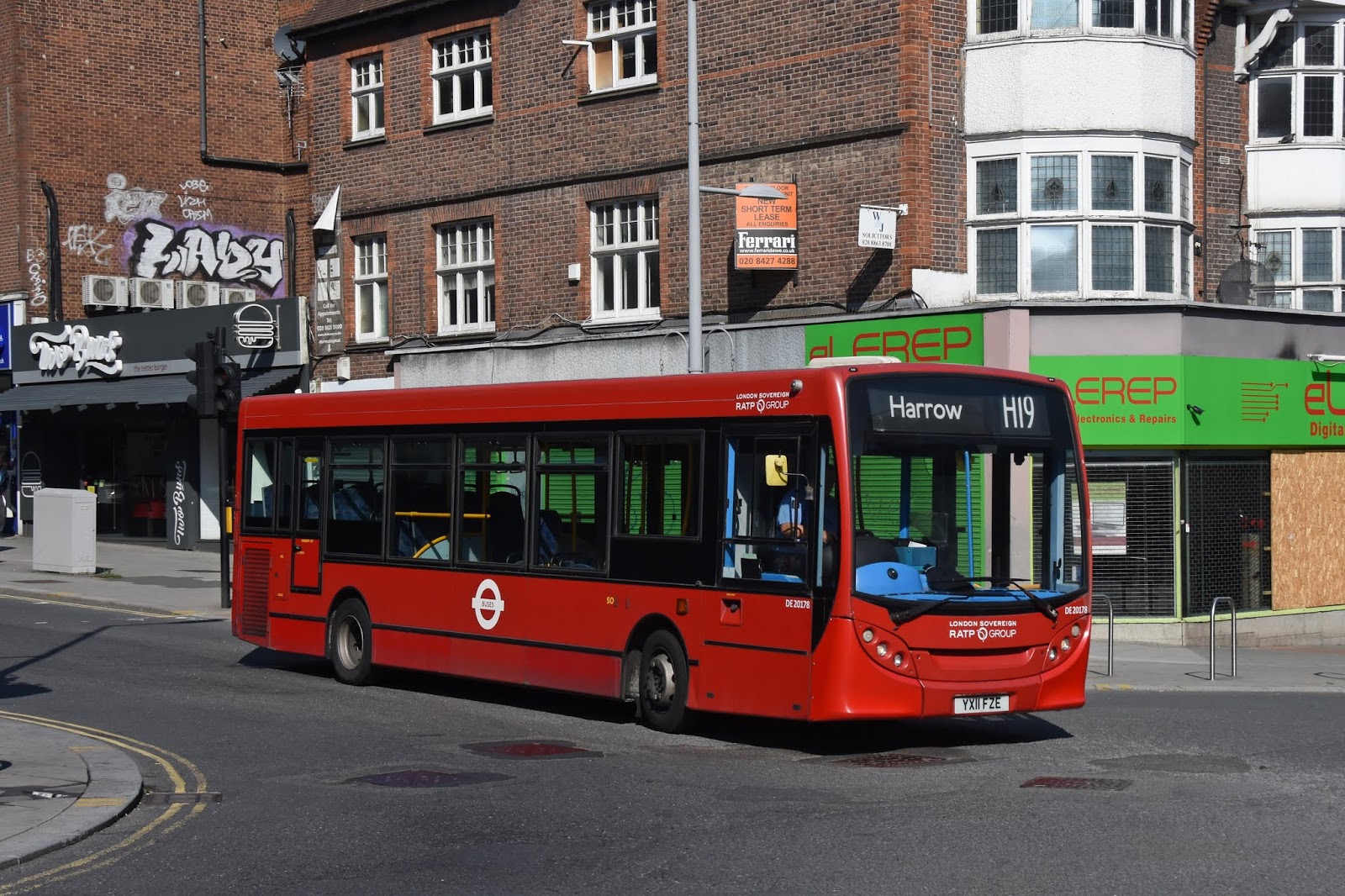
H19 DE20178 in Harrow Town Centre.
© Tommy Cooling


London Sovereign had further gains later on in 2018 with the tender wins of routes 223 and 224 from Metroline from October 13th, and the 79, also from Metroline, from December 8th. The later win for LS however was coupled with the loss of the 292, which headed in the opposite direction to Metroline.


The Wembley Changes

Old order
The 223 and 224 used a general batch of E200 DEs from Alperton that were also shared with the 487. These were stood down and returned off lease when the routes moved on Saturday 13-October.

Metroline 223 DE1962 in Harrow.
© Tommy Cooling

Metroline 224 DE1969, caught changing blinds.
© Tommy Cooling


New order
The 223 and 224 are now also operating with a fleet of DLEs, based at London United's Atlas Road (RP) garage site.


223 DLE30292 on Preston Road.
© Tommy Cooling

223 DLE30296 on Carlton Avenue East in Preston.
https://www.flickr.com/photos/127662272@N07/45414055895/in/album-72157665247070991/
© Tommy Cooling


224 DLE30312 in Alperton.
© Tommy Cooling

Further Edgware Changes

The final set of changes for the year involved the 79 and 292 swapping operators between Metroline and Sovereign at Edgware on Saturday 08-December.

Under Metroline the 79 was operated with Volvo B7 VWs, with frequent appearances of the VWH class used on the 7. The VHs ordered for the 79 were diverted onto the H91 during late Autumn to upgrade the route to Euro VI standards for the Chiswick Low Emission Bus Zone (LEBZ). The H91s SP allocation headed in reverse to Sovereign and are now in use on the 79.

The 292 ran with the last surviving examples of Scania OmniDekkas (SLEs) in London. These were progressively phased out during the route's last month as the SPs moved in in preparation for the 79. Some of the VWs which operated on the 79 moved into Edgware on the last day of the 79, to begin in service on the 292 the following day. The VWs 1200-1209 form the allocation however TEs, TEHs and VMHs have all featured during December already.


Metroline VWH2011 on the 79 in Edgware. The 79s predominant allocation was B9TL VWs.
© Tommy Cooling


RATP SLE40635 at Edgware Station.
© Tommy Cooling


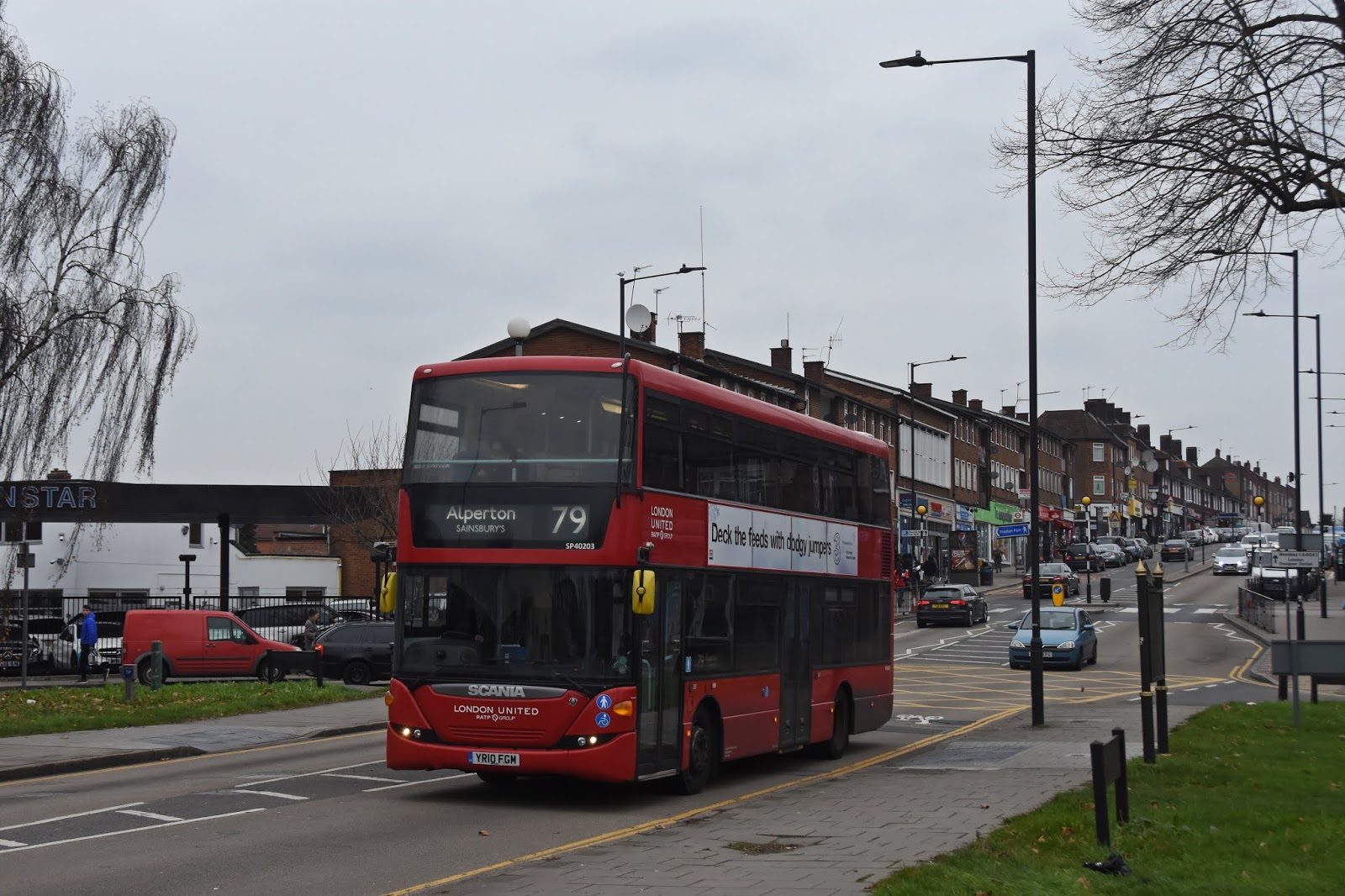
79 SP40203 on Preston Road.
https://www.flickr.com/photos/127662272@N07/32454707548/in/album-72157657904899750/
© Tommy Cooling

292 VW1205 at Colindale Superstores.
https://www.flickr.com/photos/127662272@N07/39681915183/in/dateposted-public/
© Tommy Cooling


Post by Tommy Cooling
Some of these images and more can be found on my Flickr page:
Please do not reproduce any of my images without permission