Showing posts with label Railways. Show all posts

24/04/2019

Riding La Viva Loca

In April 2017, the last D78 ran in service on the District line. After two years, D78 Stock have been revived by Vivarail into a viable alternative to new rolling stock, especially for lower-utilisation routes like the Marston Vale line, and on 23rd April 2019, the resulting DEMU Class 230 entered passenger service with London Northwestern Railway (West Midlands Trains).

London Northwestern Railway 230004, Bedford
230004 on the second day of service at Bedford.
© Aubrey Morandarte

These "upcycled" trains have, instead of a pickup shoe to pick up electricity, there is a diesel motor which drives an electric source, which is used to power the motors which are pre-existing from the D78 Stock. The bodyshell, chassis, some parts of the seating, motors and bogies are all pre-existing from the D78, whilst the interior and other major things have been added or changed.

Last D78 Stock Train.
Spot the difference? Merely two years ago, the last D78 ran in passenger service on the Underground.
© Aubrey Morandarte

There had been some testing mishaps back in 2016, when it was mooted that they would be tested on the Coventry-Nuneaton line under former West Midlands franchise operator, London Midland (Govia). However, unfazed by the setbacks in 2016, the incoming new franchise operator, West Midlands Trains (Abellio-JR East-Mitsui) took three of the Vivarail units for the Bedford - Bletchley line. As the Vivarail prototype is 230001, and the battery EMU is 230002, these took the TOPS numbers of 230003-5.


This video shows a ride between Bow Brickhill and Woburn Sands. Clearly audible are the diesel engine undertones with the distinct pre-existing D Stock motors. The ride on the trains are the same as with the D Stock, as the bogies are the same as the ones fitted to the D78s since the late 1990s/early 2000s (fitted by Adtranz). Seating is fairly comfortable considering the type of seats chosen, although the opinion may be in part due to the author's frequency of using trains with the same type of seating. The door closing can be clearly heard, and closes with greater force than when under LU ownership.
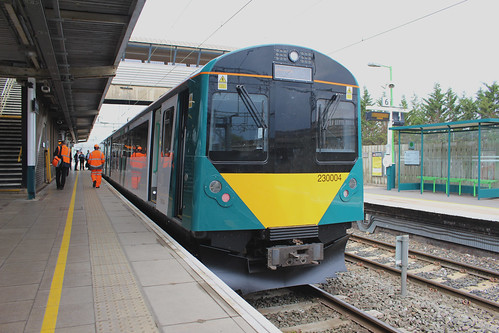
London Northwestern Railway 230004, Bletchley
230004 turns around at Bletchley for a trip to Bedford Midland
© Aubrey Morandarte

The front of the train has been slightly modified to meet modern crash worthiness standards. New LED lights replace the under-body lighting seen on the D Stock. The emergency door at the front has been plated up, and a fully modernised cab has been installed.

Interior of LNR 230004, Bedford
Interior of one coach of 230004, Bedford
© Aubrey Morandarte

One coach has been refurbished extensively, with the centre doors being boarded up. The seats between the boarded up centre doors are of the "ironing board" high backed seats, with the longitudinal being refreshed seats from the 2005-2008 refurbishment with London Underground. All seats have new moquette, and padding. Handrails have been repainted, the LED displays have been replaced internally (but the housing has not been replaced).

Interior of LNR 230004, Bletchley
Interior of the other coach of 230004, Bletchley
© Aubrey Morandarte

The second coach has the corridor-side part with the existing layout. The centre part has a similar layout until the second boarded up door, where a new accessible toilet has been installed. Yes, for the first time, one can legally go to the toilet on a D Stock.


Toilet and wheelchair space within train.
© Aubrey Morandarte

An extended wheelchair area is located next to the toilet, which is all near to the front set of doors, where four original seats are retained between the door and the cab. A mixed layout of seats overall, with a clean look. As a personal opinion, the refurbishment seems to be very neat, to the extent that some can think it was a completely new train.

Table seating on ex-door in Class 230
Table seating next to a boarded up door, note the shorter windows.
© Aubrey Morandarte

The trains are fitted with plug socket and USB charging points underneath the transverse seating, with USB chargers between seats embedded at the bottom of the arm rests next to the longitudinal seating.


Detail of the longitudinal seating, original from the mid-2000s LU refurbishment.
© Aubrey Morandarte


One thing also changed from the original D Stock is the installation of a inter-car corridor, operated by pressing a button which unlocks the first door, with the second door opening using a handle from the corridor. This introduction of the corridor has made walking between carriages safer. Also seen on the photograph on the left is the exhaust from the underfloor diesel engine.

© Aubrey Morandarte


There are posters detailing both the train's history as well as notable connections and notable information of each place on the line.
© Aubrey Morandarte


A line diagram using the former advertising panels. Further detailing of each panel can be seen:
Bletchley-Bow Brickhill
Woburn Sands-Ridgemount
Lidlington-Stewartby
Kempston Hardwick-Bedford Midland


© Aubrey Morandarte

The Marston Vale trains have special branding, with a whiter version of the LNR livery. This photo also shows the side external displays for the destination, as well as the treatment for the former doors.
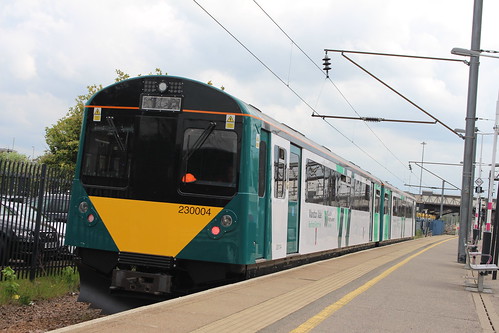
London Northwestern Railway 230004, Bedford
230004 leaving Bedford for the Marston Vale line.
© Aubrey Morandarte

Overall, these trains are a fair, refreshing low cost upgrade to the Class 150/153s that are usually on the route. Although the trains themselves are OLDER than the Sprinters that they replace, they are notably more efficient due to the electric motor driving the wheels, rather than the diesel transmission. This leads to an mpg which is lower than Pacer trains.

Vivarail have done an excellent job with the interior refurbishment, and the quietness of the engine does mean that the loudest sound is usually the motor noises, or the train announcements. The interior is more airy than their predecessors, with brighter lighting thanks to the LED interior lighting.

The main issue would possibly be the toilet sinks having too powerful water pressure at the taps, but otherwise are very good units. These are set to be the only DEMUs from Vivarail so far ordered, as the 230s for Transport for Wales will be diesel-electric hybrid trains.

Post, photos and video by Aubrey Morandarte

All rights reserved © WLTMTB 2019

03/04/2019

Moving Parliament

These services feel like a side-note in the vast essay that is the UK rail network, but all the same their importance is on equal or greater terms, and historically even more so.  They are rarely seen, usually connecting unusual stations, often running at inconvenient times and likely to be carrying no more than one man and his dog, on a good day; this of course is reference to the "Parliament" or "ghost" trains.  The Parliament service is a long-standing principle of running, sometimes as little as one train a week, and in only one direction, over sections of the railway network that would otherwise be closed.

The Parliament trains have proved a useful tactic to employ when the costs of a formal procedure for closing a specific portion of line become too unwieldy.  They can also run for other means such as refreshing driver route knowledge along diversionary routes, the latter is the focus for this post.

Chiltern Railways have operated a late morning Parliament service between South Ruislip and Paddington via the New North Main Line (NNML).  The NNML was built by the Great Western Railway (GWR) and opened between 1903 and 1905 running as a spur off the 'traditional' Great Western Main Line at Old Oak Common, running north through Greenford, before joining the Great Central Railway's (GCR) main line at South Ruislip.  The NNML continued to High Wycombe and beyond towards the Midlands and North West as a GWR & GCR joint railway [1].  Normal services ceased in 1963 and today the one passenger train that uses the line only reaches High Wycombe. This is an extension in reality as the "Parliament" service used to terminate from Paddington at West Ruislip until 2017.  The line is also used by freight workings, and prior to High Speed 2 (HS2) construction, was partly used as a method to turn GWR High Speed Train sets around from Old Oak Common.


Sign of the times; both services on the indicator boards here, now start at West Ealing.
Chiltern Railways 165 006 at Paddington.
© Tommy Cooling


Circle Line 21313 passes Chiltern Railways 165 006 at Paddington.
© Tommy Cooling

Chiltern Railways 165 006 passes Royal Oak with Paddington in the distance.
© Tommy Cooling

Chiltern Railways 165 006 passes then-First Great Western (now GWR) 165 127 at Royal Oak.
© Tommy Cooling

A 3x2 Chiltern Railways 165 DMU set passes North Acton heading towards Paddington.
© Tommy Cooling

Chiltern Railways 165 005, with Wembley Stadium in the background, passes through Perivale heading to Paddington.
© Tommy Cooling


Construction for the new High Speed 2 rail link, linking London to the Midlands and beyond [sound familiar?] is churning through the new development site at Old Oak Common, ready to become a massive interchange between from HS2 to GWR services, Crossrail and London Overground.  The NNML traverses two of the HS2 tunnel boring sites, and after 115 years since opening, the line is now severed.  A decision is yet to be made regarding whether the track will be reinstated to run a more substantive HS2 Old Oak Common connecting Chiltern service, however such a service has been muted to increase Chiltern Railways' presence and to take the strain from their Marylebone terminus.

This is not the end for the "Parliament" service however. From the December 2018 timetable change, the Chiltern Railways service from South Ruislip now runs to West Ealing leaving at the slightly later time of 11.02, diverting off the NNML at Greenford.  The return journey, now at 11.47, still runs to High Wycombe.  It waits to be seen as to whether this ghost service will ever return to Paddington, although given the congested nature of the "local lines" through Ealing Broadway and Acton, and with Crossrail around the corner, it does look unlikely.


Chiltern Railways 165 020 arrives at West Ealing.
© Tommy Cooling

Chiltern Railways 165 020 is joined by GWR 165 124 at West Ealing.
© Tommy Cooling

A busy scene with three different TOCs in view (Chiltern 165020; GWR 165124; Tfl Rail 345012)
© Tommy Cooling


[1] - Joe Brown; London Railway Atlas (2012)

Post by Tommy Cooling
Some of these images and more can be found on my Flickr page:
Please do not reproduce any of my images without permission

29/03/2019

GOBLIN update

Background
The Gospel Oak to Barking line is part of the London Overground network which runs between, yes you guessed it, Gospel Oak and Barking. More commonly however, this line is referred to as the GOBLIN, and even has their own Users Group; The Gospel Oak to Barking Rail User Group (BGORUG). The line passed from Silverlink Metro to London Overground in 2007, originally using the former operator's 2 car Class 150-1 units. The line was unique being the only LO line that was not electrified either via third rail DC current or overhead AC wires. New rolling stock arrived in 2010, 2-car class 172-0 Turbostar DMUs.


172001 at Leyton Midland Road, prior to electrification of the line
© Tommy Cooling

172003 at Leytonstone High Road, on the last day before the line closed for electrification works in June 2016
© Tommy Cooling

Within a short time frame, the London Overground success story was beginning to act as a downfall, with passenger loads rapidly increasing to beyond levels sustainable by the line's 2-car units. Plans were afoot by 2013 to increase the capacity on the line to 3-car or 4-car diesel trains, however these plans were superseded by Government plans to electrify the line throughout with brand new 4-car electric trains (class 710s). Electrification work began in 2016, and was due to be completed by 2017, however complications during these works saw the project overrun by a year, and costs escalate. Full line electrification was achieved by 2018, a year behind schedule, the brand new class 710 units, ordered in 2015, were also delayed. The units were due into service in 2017, however this was pushed by to 2018 by which time the delayed electrification project would be complete. Despite this the trains were not delivered until November/December 2018, nearly 18 months later than first planned.

172007 under the wires at Upper Holloway
https://www.flickr.com/photos/127662272@N07/46269365944/in/album-72157650255683791/
© Tommy Cooling

The complications began when the existing class 172 units were earmarked for West Midlands Trains for their May 2019 timetable change, following the end of lease with TfL in May 2018 [on the basis that the 710s would be in service]. With no immediate chance of ANY class 710s being accepted by London Overground, drivers trained, and units passed fit for service before the class 172 lease expired, TfL took out a further sub lease on the units, from West Midlands Trains (WMT), keeping them until mid-March 2019. However, as these units required refurbishment and extensive internal modifications to retro-fit toilets, for use with West Midlands Trains, some of the line's eight units, would need to be 'handed back' to the leasing company prior to this date. The first unit went early on leaving the line, which requires six trains for a full service, with only only one spare. This also saw the morning extra service, which required the seventh unit, removed from the timetable, on the basis that only six trains could be used at any one time.

January saw no progress in the readying or the likelihood of acceptable by London Overground of the 710 units. It was at this point when the second 172 returned to WMT, leaving the line with no spare units. Inevitably, with little to no significant upkeep taking place on the remaining units, the prevalence of train faults and cancelled services increased. With the late January/early February cut-off approaching for half of the remaining six 172 units to go back to WMT, an emergency stop-gap measure was needed to prevent the line losing any further services. This solution was to use three shortened class 378s, taken from the fleet's refurbishment process and one other spare unit. Three class 378s (which had been lengthened from 3-cars to 4-cars, then 4-cars to 5-cars) were shortened from 5-cars to 4-cars, the same length as the new class 710s on the GOBLIN. This meant they would easily be able to operate using the existing class 710 platform stopping markers. The first of the three units, 378232 entered service in late January, followed by two further units in February to replace a 172 that went off lease at the same time. The other two shortened 378 units are 378206 and 378209.

378232 was the first electric passenger train in service on the GOBLIN
https://www.flickr.com/photos/127662272@N07/46269365784/in/album-72157650255683791/
© Tommy Cooling

During late winter, class 710 units made late night trips over the GOBLIN to increase their fault free test running. By late February and into March, passengers were greeted to their first glimpses of 710s running on the GOBLIN in daylight hours, as train testing was vamped up.

710269 at Brondesbury on a testing and training run
https://www.flickr.com/photos/127662272@N07/32491255047/in/album-72157650255683791/
© Tommy Cooling

Where are we now?
As things currently stand services on the GOBLIN have been reduced by 50% with one electric 378 every 30 minutes following the end of the sub-lease of the final three 172 units from WMT. On most days there are up to two electric 710 units testing on the line. These generally fall into the other paths that would have been operated by passenger services; a situation that would be very frustrating for a passenger facing a long wait for the next train. Overall train capacity on the line, as TfL seem to proudly claim, has not changed, with six 2-car 172s have been replaced by three 4-car 378s, still offering 8-cars per hour. The only difference being the intervals between have increased 100% from every 15 minutes to every 30 minutes.

There is still no indication yet as to when the GOBLIN saga will finally be over, however most will feel and are hoping, that the end is in sight.


Post by Tommy Cooling
Some of these images and more can be found on my Flickr page:
Please do not reproduce any of my images without permission

26/02/2019

1938 Stock Heritage Outing in Central London

Prior to London Underground's new automatic signalling upgrade project being completed and switch on, the London Transport Museum's heritage Art Deco 1938 tube stock set made what could be a farewell heritage tour around the Central London section of the sub surface lines on the existing signalling.
 
The heritage 1938 stock is formed of two driving motor cars (DMs) 10012 [A-end] and 11012 [D-end], with one non-driving motor car (NDM) 12048, and one intermediate trailer car (T) 012256, the set comprised is formed as DMa-T-NDM-T-DMd 10012-012256-12048-11012.

The tour comprised two trips, the first from Ealing Broadway to Moorgate via and entire clockwise lap of the Circle line. The second trip comprised a run up the Metropolitan line from Moorgate to Amersham, and then back to Ealing Common via Harrow-on-the-Hill and Rayners Lane.

This post serves as a pictorial journey of this London Underground heritage outing. 

The 1938 stock set leaves South Ealing running towards Ealing Broadway to entrain for the tour.
https://www.flickr.com/photos/127662272@N07/47148298432/in/dateposted/
© Tommy Cooling

The 1938 stock set passes through Baker Street on its lap of the Circle line.
https://www.flickr.com/photos/127662272@N07/32266063337/in/photostream/
© Tommy Cooling

The 1938 stock set at Gloucester Road.
https://www.flickr.com/photos/127662272@N07/46484991544/in/photostream/
© Tommy Cooling

The 1938 stock set resting between trips at Moorgate.
https://www.flickr.com/photos/127662272@N07/46484991814/in/photostream/
© Tommy Cooling

The 1938 stock set viewed from Mapesbury Bridge in Kilburn, heading up to Amersham.
https://www.flickr.com/photos/127662272@N07/47148299742/in/photostream/
© Tommy Cooling

The 1938 stock set leaves Harrow-on-the-Hill on its penultimate journey to Rayners Lane.
https://www.flickr.com/photos/127662272@N07/47148298902/in/photostream/
© Tommy Cooling
 
STOP PRESS: The LTM Friends have announced a further heritage outing for the 1938 stock on Sunday 15th March on the District line to Upminster, with tickets due to go on sale very soon.


Post by Tommy Cooling
Some of these images and more can be found on my Flickr page:
Please do not reproduce any of my images without permission

21/05/2018

Crossrail[ing] it to the West side

The May 2018 timetable change saw the second unfurling of the TfL Rail network, prior to the full unveiling of the Crossrail Elizabeth Line service (and brand) in 2019.


On Sunday 20th May, the former GWR Heathrow Connect services between Paddington and Heathrow T4 transferred over to TfL. This service has retained the existing class 360s for the time being on the T4 services due to current incompatibilities between the BAA Heathrow signalling and the new Class 345s. Going forward, these services will also be run by the new Class 345s to T4, (and then T5 from 2019).

TfL 360203 at Paddington
© Tommy Cooling

The former Heathrow Connect 360s showing their temporary TfL Rail branding from day one; better than some TOCs ...
© Tommy Cooling

New TfL Rail line diagrams graced the 360s from day one
© Tommy Cooling

TfL Rail 360203 stands at Heathrow T4
© Tommy Cooling
https://www.flickr.com/photos/127662272@N07/40442407050/in/photostream/


Monday 21st May saw the introduction of the Class 345s into passenger service on the Great Western side, running between Paddington and Hayes & Harlington, as the Hayes short workings are not timetabled to operate on Sundays. These workings used to be operated by 8-car GWR Class 387 Electrostars.

TfL Rail 345014 arrives at Hayes & Harlington
© Tommy Cooling
https://www.flickr.com/photos/127662272@N07/27379014087/in/photostream/


TfL Rail 345014 and GWR 387150 at Hayes & Harlington
© Tommy Cooling

TfL Rail train to Paddington
© Tommy Cooling

Interior of the Old Oak Common based TfL 345s in use on the GWML
© Tommy Cooling

TfL Rail 345014 at Paddington
© Tommy Cooling

TfL Rail 345017 at Acton Main Line
© Tommy Cooling
https://www.flickr.com/photos/127662272@N07/41384058425/in/dateposted/

Post by Tommy Cooling
Some of these images and more can be found on my Flickr page:
Please do not reproduce any of my images without permission

19/12/2017

A RAT for one final time

The autumnal rail adhesion season on the Metropolitan line was supposed to be the last year that London Underground would use the A60 Stock for sandite duties. With the withdrawal of the entire fleet of D78 Stock, two four car units (five car with the sandite car added) have been retained, with two converted sandite cars. The aim being to replace the ageing 50+ year old stock on the Met.

This process was covered in a blog post at the end of last year [2016], however electric, mechanical and paperwork issues with the newly converted D stock sandite trains has meant that the A stock was reprieved for the 2017 season. The set, 5110-5111, was to be kept as a strategic spare for the 2017 leaf fall season but it was never intended to be used.

This year, like last, IS expected to be the last year for the A. This year should in fact, baring a substantial change in events, the very last for the A as it cannot be operation beyond Spring 2018 due to needing a massive and costly overhaul. For London Underground to keep the set active beyond this time they would have to heavily invest in the unit, at a time when they are already investing loads into its replacement.

I wrote a similar blog post around this time last year which covered the switch from A stock to D stock, which at time of writing had not taken place (From A to D but not via C: http://wltmauc.blogspot.co.uk/2016/12/from-to-d-but-not-via-c.html), so this post will purely act as a pictorial summary of really does appear [and in fact did turn out] to be the Metropolitan line's A Stock farewell!


DM 5111 brings the RAT into Rayners Lane early on in October.
© Tommy Cooling

Later the same day, 5111 is seen heading the train through Pinner.
© Tommy Cooling

5111 passes through Harrow, the unofficial home of the Met heading for Neasden in mid-October.
© Tommy Cooling


5111 on the approach to Hillingdon at dusk in late October.
© Tommy Cooling

In early November, 5110 is seen leading into Harrow.
© Tommy Cooling
5110 heads into a seasonal looking Pinner following the December snow fall, on what turned out to be its last day in service.
© Tommy Cooling
5110 pausing at Uxbridge, on what turned out to be its last visit.
© Tommy Cooling

5110 shunting from the siding at Harrow sporting an appropriate destination, kindly staged for the photo.
© Tommy Cooling

STOP PRESS
On Monday 11th December the unit developed a fault, and upon subsequent inspection at Neasden, turned out to be a significant and costly motor issue. The decision was made from high up within London Underground that the unit would not be repaired and so on Wednesday 13th, A Stock 5110+5111 was officially withdrawn from service after 55 years, and the 2017 RAT season on the Met was terminated.

Two five-car D Stock units will run on the Met for leaf-fall from 2018, one operational unit and a spare back-up.


Post by Tommy Cooling
Some of these images and more can be found on my Flickr page:
Please do not reproduce any of my images without permission