03/06/2019

Go-Sutton, Go

This will be a post that is not in the usual format, as it will be done completely in the first person experience. This reflects the personal experience of the blogger, and is not representative of the rest of the blog team's views:

Go-Ahead London MB5 on Go-Sutton, Sutton Station
MB5 stands at Sutton Station awaiting a request.
© Aubrey Morandarte

Transport for London, Go-Ahead London and ViaVan partnered to launch the first demand-responsive transit system within London. Go Sutton, launched on 28th May 2019 with Mercedes-Benz Sprinter minibuses akin to the one shown above, based in Sutton Garage. I will take one though the process of booking one journey with Go Sutton.

Registering:

Downloading the application is not as easy, with the Go Sutton app not being within the first few results when searched on Google Play. Of course, one can use the link on the Go Sutton website, but I persisted with the search, and it came up as the 7th option. Eventually, as the application becomes popular, it'll rise in the search results.

View when first opening GoSutton App
A log in/sign up screen is shown once opening the application for the first time. It is easy enough for most people to input an email account, password and a profile picture. Then, one has to input their payment details.

There are a few ways to pay:

Payment through the application on a debit/credit card, details are entered as part of the profile registration. I used this method.

Entering the Freedom Pass Oyster Card number, allowing free rides using said Freedom Pass.

Email GoSutton if one has a ENTCS (English National Concessionary Travel Scheme) pass to activate free rides.

Calling the support number as seen on https://gosutton.co.uk/

Texting their mobile number as seen on https://gosutton.co.uk/


Booking a ride:
This is an example drop-off point.
Beddington Corner (Goat Road).

This is an example pickup point.
The Crescent, Belmont.

Once the method of payment is sorted, one is taken to the map and asked to pin a pickup point.

This example journey will begin within Belmont, just south of the rail station. This is the southern extremity of the Go Sutton area.

To test the scope of the service, I took a journey to the northern extremity of the Go Sutton area, at Beddington Corner. This is 7 minutes away from Mitcham Junction Tram/Rail Station, but due to arbitrary borough boundaries, the journey will end at the edge of the Go Sutton area.


Choosing the pickup and drop off places from a map is very easy to deal with, and can either be placed on the map close to the GPS location, or searched in the search bar. Once these places are entered (within the network area), the application will automatically find any drivers nearby that are able to make the journey, and will give at least one option within 10 minutes away from your pickup point.
It seems that this vehicle has
come from another residential
area, thus it could be moving
from a drop-off in another area
in Banstead.

I have blurred out my card details
for obvious reasons.

Usually the pickup point will be within a few minutes walk, usually at the nearest junction or open space from the requested pickup point. As shown here for me, the pickup is at the junction between two roads (The Crescent and Queens Road).

Once all details have been confirmed, the rider is asked to book the ride, as seen to the left. The cost for the ride is £3.50, which for some journeys, seems reasonable considering that multiple changes between rail and bus may be required to link between two places, which can make some journeys cheaper via Go Sutton. 

The vehicle that I will be using is tracked, and it is shown that BN17JFX will be my vehicle for the ride to Beddington Corner. I saw it moving closer to me as the map updated in real time, and a notification popped up when the vehicle was two minutes away or less.


Ride:
Go-Ahead London MB6 on Go-Sutton, Banstead
MB6 arriving at the pickup point to take me to my destination.
© Aubrey Morandarte
Promptly, the bus arrived. The driver asked whom my name was, just to confirm I was the passenger required, before hopping on. I took a seat at the rear of the bus.

The amenities included were:
Free wi-fi provided by Icomera.
USB charging sockets at every seat.
Leather seating.
Seat belts (mandatory by law).

MB6/BN17JFX itself is formerly a Evobus demonstrator, which has seen notable use in Cumbria with Stagecoach prior to use in the Go Sutton trial. All but two buses are demonstrators on loan to Go Sutton.

Interior of Go-Ahead London MB6
Interior of MB6 during my ride to Beddington Corner.
© Aubrey Morandarte
The friendly driver was to follow the directions shown by the tablet at the front of the bus, just by the driver's side where a ticket machine would normally be. It is a basic satellite navigation system which may change routing dynamically in order to respond to demand for people to travel to similar places e.g. Sutton Town Centre, St Helier Hospital.

However, problems struck the directions, as the satellite navigation directed us to go out of the operating area, and out of London. It told us to take the second exit of a roundabout with the main road out of Belmont, instead of the first. However, the driver managed to turn us around at the next intersection to get us back on track. She apologised for the error numerous times, with a clear level of sincerity, and I appreciated that she apologised. It did not affect the journey too badly, and it was understandable as teething problems.

The welcome message to the wifi.

The ride itself was fairly uneventful, ignoring the initial mishap. I had to try the in-built amenities. The USB charger started to charge my phone well, managing to add 5% of charge with a poor wire. A decent wire would be able to charge a phone slightly more with the approximately 28 minute journey (well, 20 minutes without the diversion).

The wi-fi has a limit mandated by Icomera with a 50MB limit. This allows for basic internet, including sending messages. Sending images are limited due to bandwidth. It had no problem running applications including Spotify, and sending messages to Discord. It cannot load a video well in YouTube.

Anyway, closer to the end of the journey, a text was sent automatically from Go Sutton, telling me that my drop off was coming up, and to check for all of my belongings. I felt this was a nice touch, especially as one could be consumed by being on their phone during the short ride.

Rear of Go-Ahead London MB6, Beddington Corner
MB6 dropping me off at Beddington Corner.
© Aubrey Morandarte
The drop-off was slightly off my original drop-off pin, as the driver was slightly unsure where I should be dropped off, but it was very close, and at a safe grass verge at the green around Beddington Corner. 

Verdict:

Honestly, the experience with Go Sutton was pretty good. Yes, there were some teething problems, but overall, the experience seemed to be overwhelmingly positive. The ride of the Mercedes Sprinter City was as good as a van derived bus could be. It wasn't the greatest, but it was expected. Driver was well presented, and provided great service. I expect the teething problems to be ironed out over time, but the experience is good considering the relative unknown quantity of demand responsive transit in London.

Once the service gets more custom, it is expected that journey times will increase as buses will divert slightly in order to hook more people up with fellow people heading in a similar direction. Worst case scenario would be where the £3.50 could make it not worth the extra fare from the fare of the bus/train. It is not intended for the service to be a cheap taxi, but it fulfilled that role for me on the day of the ride. It does provide an alternative that rides between a taxi/minicab and public transport, where it is priced between the two, but also has the convenience level which is between the two. It will take time to whether the service becomes either a glorified Dial a Ride, or an actual alternative to low demand, low frequency bus routes in hard to serve residential areas, and supplementing the existing network.

As the whole thing is a trial, along with the Ealing DRT later on this year, it will not be integrated with the TfL ticketing systems. Hopefully this will be addressed after the 12 month trial, if TfL decide to continue with this experiment. It certainly seems that Go Sutton is used though.

Comparison:

Quality Line OM20236 on Route S1, Mitcham Junction
OM20236 with a broken display on Route S1 enroute to Banstead, at Mitcham Junction.
© Aubrey Morandarte
To compare, the alternative was the direct bus S1 between Beddington Corner and Belmont Station. I took the S1 between those points and the journey was less than impressive, even ignoring the fact that it was a bus route, and had to go through Sutton Town Centre. The Go Sutton ride took me via Carshalton, avoiding the traffic around Sutton.

The journey took nearly 50 minutes, and the bus was certainly busy. Especially around the Sutton area, the bus was notably crowded with 3 buggies taking the wheelchair area notably. The bus comfort was not great, with idling vibrations being a key downside to the bus ride. It is £1.50 though, and good value considering what is on offer in terms of bus fares in other parts of the country, even though the fares do not reflect the actual costs at times. Go Sutton is quicker, albeit more expensive, hence there is the trade off to think when planning a journey. Also, as the Go Sutton service is restricted to within the London Borough of Sutton, Mitcham Junction Station is not included in the area even though it is only 7 minutes walk from Beddington Corner.

Later on this year, there will be a trial of DRT in Ealing with the partners being MOIA and RATP, and it will be interesting to see the differences and similarities between the two DRT operations.

Post by Aubrey Morandarte
Screenshots are from the Go Sutton application

All rights reserved © WLTMTB 2019

22/05/2019

Great West Abellio

On 6th April 2019, Routes 207 and N207 transferred from Metroline West to Abellio London West, giving Abellio a very large stronghold in West London. Both routes will eventually be based in the upcoming permanent Southall Bus Garage in the Great Western Industrial Park, but in the meantime, are based in the former Wings Buses base at Hayes.

Abellio London 2005 on Route 207, White City Bus Station
2005, one of the few new buses ordered for the 207, starts the journey on the first day to Hayes By-Pass. Most of the allocation is compromised of existing classic and MMC Enviro 400s made spare by a reduction on Route 415, as well as the complete withdrawal of Route C2.
© Aubrey Morandarte

The gain of the 207/N207 offsets the loss of Route C2 to the Central London bus cuts, and along the 211 loss, offsets the 24 and 27 tender gains. The relatively small base of Hayes that Abellio has means that they had to shuffle a few routes to accommodate the 207/N207. Routes 195 and U5 moved to Fulwell (TF). Routes U7 and part of H28 moved to the temporary Southall (AB).

Abellio 9534 beside Westfield White City on Route 207 towards Hayes By-Pass.
 Abellio's 9534 was a Battersea (QB) C2 bus, transferred after the withdrawal of the route.
© Tommy Cooling
Other buses which were not affected by the C2 withdrawal also made their way to Hayes from their eastern counterparts, with some Enviro 400H MMCs from the 415, as LTs replaced part of the allocation for the route. Also, other non-C2 buses were also transferred to the route from QB, albeit temporarily.

Abellio London 2467 on Route 207, Ealing Broadway
2467 from the batch intended for the 49 was transferred over to Southall for a few days from the initial contract change. This bus is now back at QB for the 49.
© Aubrey Morandarte

Abellio 2532 in Ealing Common on Route 207 towards White City.
This is one of three different E400 MMC batches that can appear on the route, this batch having transferred from the 415.
© Tommy Cooling

Abellio's MMC batches from 2015, 2017 and 2019 all appear in this one view, and any of these vehicles can be allocated to the routes. Note how the rear of the body type has changed between the 2015 model and the latest 2019 version.
© Tommy Cooling
Although the 207 now shares the 427 allocation, it is infrequent for the 427 branded buses to stray onto the 207/N207, although this has happened in the past as the N207 mainly draws its allocation from the 427 due to the Central London Ultra Low Emission Zone (ULEZ) and that the 427 is the allocated hybrid route out of WS.

Two classic E400s pass close to Ealing Common Station.
© Tommy Cooling
Abellio London 2004 on Route N207, Oxford Street
2004 heads along Oxford Street close to the end of its journey to Holborn.
© Aubrey Morandarte

The N207 was also converted from diesel operation under Metroline West to full Euro VI hybrid operation under Abellio to comply with the Central London ULEZ. It was one convenient sweep to help one of the last few diesel night routes within Central London to convert to hybrid. Other routes that were also still diesel were converted to hybrid through re-allocation of garage.

Abellio London 2401 on Route N207, Tottenham Court Road
2401 is an outlier to the rest of the decker fleet transferred for the 207, as it was not refurbished at all since introduction on the 188. It was transferred from WL to QB at some point, and since went to AB (Southall) for the E1 for a week prior to the 207 gain. It is seen on the N207, starting a journey to Uxbridge.
© Aubrey Morandarte

Abellio London 2532 on Route N207, Oxford Circus
2532 on Oxford Street on the first night of Abellio on the N207
© Aubrey Morandarte

The N207 is the first Abellio London West night service, with the closest prior being the early morning airport journeys on the 350 and 490. As with usual with current TfL policy, the night route has had an element of reduction, with the last few journeys being cut back or withdrawn. The route retains its half and half approach to the western termini, with Hayes By-Pass alternating with Uxbridge between buses.

Unlike the rest of the Uxbridge Road corridor, the 607 retained its operator and new Volvo B5LH/MCV EvoSeti buses were ordered for the route, although due to circumstances regarding electric buses and the Central London ULEZ, not all of the new buses are currently on the route.

Metroline VW1820 beside Westfield White City on Route 607 towards Uxbridge.
A number of these former 427 then 207 VWs continue to ply their trade along the Uxbridge Road, now on the 607. Their time is limited like the route. The remainder of the 607s new VMH allocation can be found on the 43 and 134 because of the Central London ULEZ. They will all be united at Greenford on the route once Metroline's electric buses arrive during summer 2019.
© Tommy Cooling

The blinds in these former Hayes 427 VWs have not been altered since the introduction of these vehicles by First London in 2010, at a time before the 207 and 607 routes were extended to serve the Westfield White City bus station. When these VWs were reused on the 207 after Metroline lost the 427 in 2017, a dayglo "White City" was added for the 207.  These vehicles have been reused again on the Uxbridge Road for the 607 this time, and a clever bit of coding was to also reuse the 207s dayglo White City as a temporary measure until the remained of the 607s VMHs are released.

When the blinds were order for these former First London Hayes VNs for the 427, a conjoined Hayes-Greenford set was designed to give the engineers flexibility if they wished to swap buses. The 607 was not at either garage at the time and was never planned to be moved to either so its inclusion on this [still original First London] blind was a chance encounter as the blind order was hurried and the base for the blinds was taken from an older version from First's Acton Tram depot blinds.
© Tommy Cooling

Metroline VMH2591 showcases the 607s official allocation in Ealing Common, sporting an appropriate yet traditional blue "limited stop" bus blind to distinguish the route from the slower 207 and 427 counterparts. This is still the only TfL route which has blue on white blinds.
© Tommy Cooling

Up to 13 VWs at Greenford can still be found on the 607; VW1818 is one of those seen nearby to Ealing Common Station.
© Tommy Cooling

This significant tender has notably shifted a lot of work to Abellio London West. The sector started out as Tellings Golden-Miller, with not a large amount changing under Travel London duress. Abellio has managed to grow this sector from a relatively medium-scale operation to a large scale operation including trunk routes which were the stronghold of Metroline West. With the new garage in Southall (GW) replacing both WS and AB, this is clearly a time of growth for the company. Adding the gains of Routes 24, 27, 267, E10 and E11 to the repertoire, as well as the retention of most of their work shows a period of growth for this operator.

Post by Aubrey Morandarte and Tommy Cooling

All rights reserved © WLTMTB 2019

24/04/2019

Riding La Viva Loca

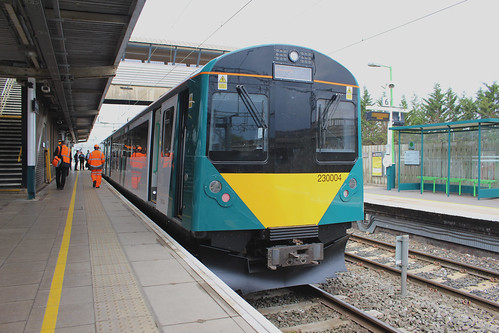
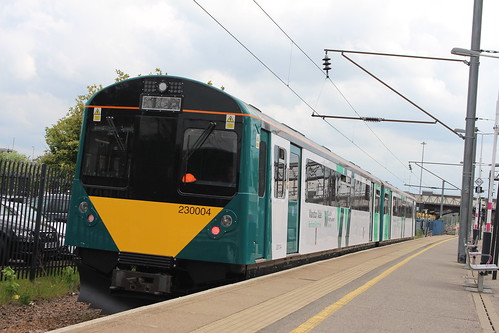
In April 2017, the last D78 ran in service on the District line. After two years, D78 Stock have been revived by Vivarail into a viable alternative to new rolling stock, especially for lower-utilisation routes like the Marston Vale line, and on 23rd April 2019, the resulting DEMU Class 230 entered passenger service with London Northwestern Railway (West Midlands Trains).

London Northwestern Railway 230004, Bedford
230004 on the second day of service at Bedford.
© Aubrey Morandarte

These "upcycled" trains have, instead of a pickup shoe to pick up electricity, there is a diesel motor which drives an electric source, which is used to power the motors which are pre-existing from the D78 Stock. The bodyshell, chassis, some parts of the seating, motors and bogies are all pre-existing from the D78, whilst the interior and other major things have been added or changed.

Last D78 Stock Train.
Spot the difference? Merely two years ago, the last D78 ran in passenger service on the Underground.
© Aubrey Morandarte

There had been some testing mishaps back in 2016, when it was mooted that they would be tested on the Coventry-Nuneaton line under former West Midlands franchise operator, London Midland (Govia). However, unfazed by the setbacks in 2016, the incoming new franchise operator, West Midlands Trains (Abellio-JR East-Mitsui) took three of the Vivarail units for the Bedford - Bletchley line. As the Vivarail prototype is 230001, and the battery EMU is 230002, these took the TOPS numbers of 230003-5.


This video shows a ride between Bow Brickhill and Woburn Sands. Clearly audible are the diesel engine undertones with the distinct pre-existing D Stock motors. The ride on the trains are the same as with the D Stock, as the bogies are the same as the ones fitted to the D78s since the late 1990s/early 2000s (fitted by Adtranz). Seating is fairly comfortable considering the type of seats chosen, although the opinion may be in part due to the author's frequency of using trains with the same type of seating. The door closing can be clearly heard, and closes with greater force than when under LU ownership.

London Northwestern Railway 230004, Bletchley
230004 turns around at Bletchley for a trip to Bedford Midland
© Aubrey Morandarte

The front of the train has been slightly modified to meet modern crash worthiness standards. New LED lights replace the under-body lighting seen on the D Stock. The emergency door at the front has been plated up, and a fully modernised cab has been installed.

Interior of LNR 230004, Bedford
Interior of one coach of 230004, Bedford
© Aubrey Morandarte

One coach has been refurbished extensively, with the centre doors being boarded up. The seats between the boarded up centre doors are of the "ironing board" high backed seats, with the longitudinal being refreshed seats from the 2005-2008 refurbishment with London Underground. All seats have new moquette, and padding. Handrails have been repainted, the LED displays have been replaced internally (but the housing has not been replaced).

Interior of LNR 230004, Bletchley
Interior of the other coach of 230004, Bletchley
© Aubrey Morandarte

The second coach has the corridor-side part with the existing layout. The centre part has a similar layout until the second boarded up door, where a new accessible toilet has been installed. Yes, for the first time, one can legally go to the toilet on a D Stock.


Toilet and wheelchair space within train.
© Aubrey Morandarte

An extended wheelchair area is located next to the toilet, which is all near to the front set of doors, where four original seats are retained between the door and the cab. A mixed layout of seats overall, with a clean look. As a personal opinion, the refurbishment seems to be very neat, to the extent that some can think it was a completely new train.

Table seating on ex-door in Class 230
Table seating next to a boarded up door, note the shorter windows.
© Aubrey Morandarte

The trains are fitted with plug socket and USB charging points underneath the transverse seating, with USB chargers between seats embedded at the bottom of the arm rests next to the longitudinal seating.


Detail of the longitudinal seating, original from the mid-2000s LU refurbishment.
© Aubrey Morandarte


One thing also changed from the original D Stock is the installation of a inter-car corridor, operated by pressing a button which unlocks the first door, with the second door opening using a handle from the corridor. This introduction of the corridor has made walking between carriages safer. Also seen on the photograph on the left is the exhaust from the underfloor diesel engine.

© Aubrey Morandarte


There are posters detailing both the train's history as well as notable connections and notable information of each place on the line.
© Aubrey Morandarte


A line diagram using the former advertising panels. Further detailing of each panel can be seen:
Bletchley-Bow Brickhill
Woburn Sands-Ridgemount
Lidlington-Stewartby
Kempston Hardwick-Bedford Midland


© Aubrey Morandarte

The Marston Vale trains have special branding, with a whiter version of the LNR livery. This photo also shows the side external displays for the destination, as well as the treatment for the former doors.

London Northwestern Railway 230004, Bedford
230004 leaving Bedford for the Marston Vale line.
© Aubrey Morandarte

Overall, these trains are a fair, refreshing low cost upgrade to the Class 150/153s that are usually on the route. Although the trains themselves are OLDER than the Sprinters that they replace, they are notably more efficient due to the electric motor driving the wheels, rather than the diesel transmission. This leads to an mpg which is lower than Pacer trains.

Vivarail have done an excellent job with the interior refurbishment, and the quietness of the engine does mean that the loudest sound is usually the motor noises, or the train announcements. The interior is more airy than their predecessors, with brighter lighting thanks to the LED interior lighting.

The main issue would possibly be the toilet sinks having too powerful water pressure at the taps, but otherwise are very good units. These are set to be the only DEMUs from Vivarail so far ordered, as the 230s for Transport for Wales will be diesel-electric hybrid trains.

Post, photos and video by Aubrey Morandarte

All rights reserved © WLTMTB 2019