22/12/2016

Kurz Quality

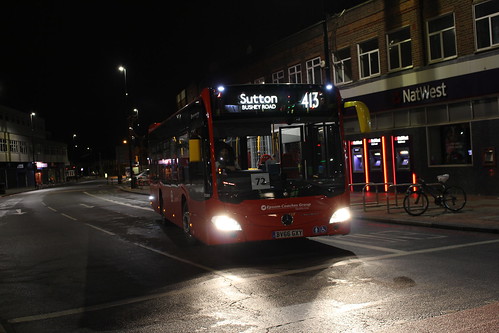
Quality Line MCS01 on Route 413*, Morden Station
Quality Line MCS01 on Route 413, Morden Station (© Aubrey)

Yet another returning operator for a route, this time, it's Epsom Coaches (Quality Line). Quality Line only ran the 413 between 1997 and 2001, sandwiched between London General spells.
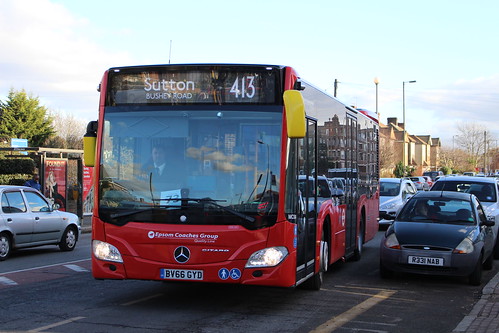
Quality Line MCS06 on Route 413*, South Merton*
Quality Line MCS06 on Route 413, South Merton (© Aubrey)

During that spell with Quality Line, Darts were used. From the 3rd December 2016, a more unique approach has taken place with these new Mercedes-Benz Citaro Ks (K - Kurz - short). This includes the well known MCS10, formerly MBK1 back in 2013 with Quality Line (see post on MBK1). After that post, it had spells with Stagecoach London (Route 380) and London United (Route 110) It still has its LED displays. This means that this working can happen again:
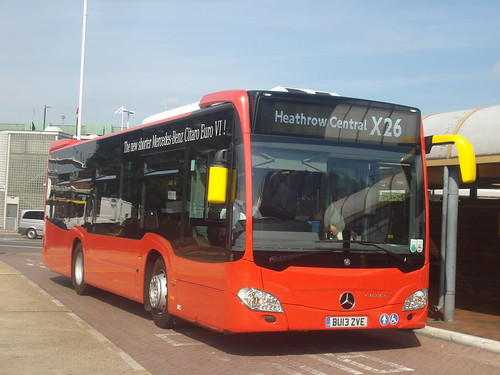
Evobus Quality Line MBK1 on Route X26, Heathrow Central
Quality Line MBK1 on Route X26, Heathrow Central (CC Aubrey)

Quality Line liked the demonstrator so much, they bought the batch for the 413. They already have full-length Citaros for the X26, and Mercedes-Benz coaches, so it felt logical to continue with their good partnership with Evobus (the sellers of Mercedes-Benz buses/coaches in the UK).
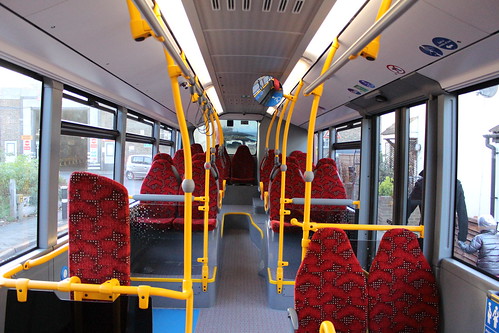
Interior of Quality Line MCS05 on Route 413*, Sutton Garage
Interior of Quality Line MCS05 on Route 413, Sutton Garage (© Aubrey)

The MCSs also introduce a new moquette to Quality Line. As these are pretty small buses, but have an engine usually used to power the larger Citaro, these buses are pretty good on their acceleration. However, these buses are also much heavier than the other buses that are already in service which do similar jobs.
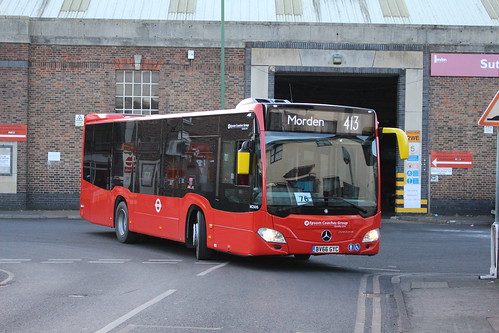
Quality Line MCS05 on Route 413*, Sutton Bus Garage
Quality Line MCS05 on Route 413, Sutton Bus Garage (© Aubrey)

These buses are pretty good to ride, and smooth. It did attract interest amongst other enthusiasts, with many riding the route (although not so many I saw, because I forgot Southern ran to Sutton from West Croydon...). The 413 otherwise came from peak hour journeys on the 213, but removed from its original haunts by being removed from Belmont. It now is a residential route from Sutton to Morden via West Sutton and Lower Morden.
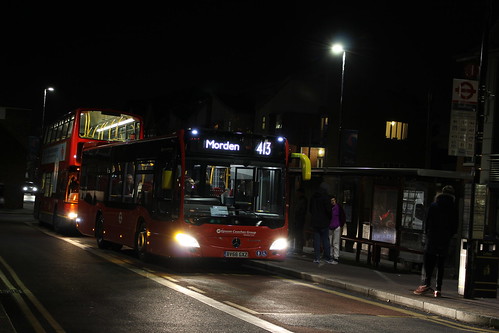
Quality Line MCS02 on Route 413*, Sutton
Quality Line MCS02 on Route 413, Sutton (© Aubrey)

Overall, a pretty decent ride, and these durable buses should be running the 413 pretty well for the next few years.
The next and currently the last lot of Citaro Ks will go for the 110 with London United with its new contract in 2017.

20/12/2016

Picture Archive Post 54


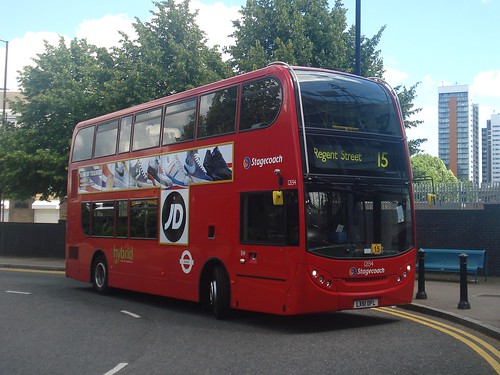
Stagecoach London 12134 on Route 15, Blackwall Station, 30/06/12
Stagecoach London 12134 on Route 15, Blackwall Station, 30/06/12 (© Aubrey)

12134 is an ADL Enviro 400H ordered for the 15, and ran the 5 (N15 duties), 8, 15, 205, N15 from Bow Garage until 19th March 2015, when the bus transferred to Leyton Garage for Route 56. It was ordered initially (and still is in) a special hybrid bus version of the Stagecoach interior, and this is the only batch of London buses in this interior specification. All other future hybrid Stagecoach buses are in the normal Stagecoach specification.

Route 15 started out as a cross-city route running from Acton and Ladbroke Grove to East Ham and Becontree Heath. It had journeys to Dagenham and North Woolwich in 1936, but was standardised to become Acton Vale (Sunday)/Ladbroke Grove-East Ham by 1937. STs, TDs and original LTs ran the route back then. From November 1947, the route was extended to Kew Green on Sundays via Gunnersbury Avenue. From 1948, the RT/RTW/RTL started to be the mainstray for the route, from Upton Park (U) and Middle Row (X) garages. 1964 saw the introduction of the Routemasters, which lasted on the route until 2003. From 1969, the Kew Green extension became seasonal, and at all other times, the 15 ran to Acton on Sundays. 1972 saw the Kew Green extension be extended to Kew Gardens. From 1975, the extension to Kew was again extended, this time to Richmond Bus Station, and all year round. This lasted until 1981, when it was replaced with the 7, and the 15 ended up with East Acton (Sunday)/Ladbroke Grove-East Ham. Middle Row moved to Westbourne Park in 1981, and their allocation on the 15 ended in 1982. In 1985, the route was rerouted to go via Tower of London. In 1987, the 15 was withdrawn from East Acton, and a deviation via Bank was introduced on Monday-Saturday replacing 15A. On Sundays, the route was converted to OPO with Titans. Under sectorisation, Centrewest gained an allocation from Westbourne Park on the 15 between Ladbroke Grove and Aldgate, and East London continued on the whole 15. In 1991, the route was extended from Ladbroke Grove to Westbourne Park.

In 1992, as part of widespread Central London changes, the 15 was split into the 15 and 23. The 23 took Ladbroke Grove-Liverpool Street, and 15 took Paddington-Canning Town (East Ham evenings/Sundays). However, on Sunday, there was no change. Centrewest involvement ended, and since it has stayed with East London/Stagecoach/ELBG/Stagecoach. The Sunday element also gained Scania double deckers. In 1993, the 23 replaced the northern part of the 15 completely. In 1999, the OPO element was made low-floor with Tridents. Also, the 15B was renumbered 115 (18/09/99) and the 15 was rerouted from Canning Town to Blackwall DLR Station at all times except evenings.
On 30th August 2003, the Routemasters were replaced with Tridents, and the route was withdrawn from East Ham, White Horse as the 115 was introduced in evenings. The route also moved from Upton Park to Bow (BW). In October 2007, the route was extended within Paddington to the Paddington Basin development. The route was withdrawn between Oxford Circus/Regent Street and Paddington in 2010 when the short-lived 159 extension to Paddington Basin took place. In 2011, the Tridents were replaced by Enviro 400Hs. Due to "Crossrail works", the route was further retracted "temporarily" from Oxford Circus to Trafalgar Square in 2013. This arrangement is expected to be permanent for the 15, but not for the N15. From March 2015, the Borismaster took over, as covered in this post. Other than workings off the N15, the 15 is now fully LT.

18/12/2016

From A to D but not via C

Home of the Metropolitan line, and loved by most rail enthusiasts and staff alike, the last surviving sets of London Underground's A60/62 Stock are bowing out after around 55 years of riding the rails of Metro Land.

New to the Metropolitan line in 1960, the A Stock was at the cutting of technology at the time and had the hard task of replacing the Met's Bobo-electric loco hauled services from the City to Rickmansworth, and the subsequent steam services beyond up to Amersham and Chesham with the extension of electrification. They were built in 4 car sets, but have usually operated in 8 car formations, comprised of two sets, 4+4. They operated in 4 car sets during off peak times on the main line in the 20th century, and on the Chesham shuttle, which ceased in December 2011. In addition, A Stock was also used as 4 car trains on the East London Line, where the underground stations required the short formation of stock, especially at Wapping and Rotherhithe.

The A Stock has been the mainstay of the Metropolitan line from the 1960s up until 2012 when it was replaced by new 8 car sub-surface stock, S Stock built by Bombardier. The A Stock also saw life on the East London Line towards the end of the 20th Century up until December 2007 when the line was closed for refurbishment and extension works to become part of the new London Overground network, which opened in April 2010.


A Stock unit 5088 stands at Shoreditch on the East London Line, two days prior to permanent closure of Shoreditch station. (© Tommy)


A Stock unit 5110 at Amersham whilst operating heritage trips for the LU150 Trip to Metroland weekend in conjunction with the Rickmansworth Festival. (© Tommy)


A Stock 5110 at Harrow-on-the-Hill, the "Home of the Metropolitan Line", whilst working the usual autumnal rail adhesion duties. (© Tommy)


A Stock 5111 passes through North Ealing station on the Piccadilly line due to the very poor quality of rail which ultimately led to the closure of the Rayners Lane branch for a few days in November 2016, and contributing factor to the very limited service on the Piccadilly line in autumn 2016. (© Tommy)


The future of the Metropolitan and Piccadilly line's rail adhesion lies in the hand of a converted 5 car D Stock 7010 and 7123. Unit 7123 is seen passing through South Harrow on a test run in December 2016. (© Tommy)
 
The interior of the A Stock taken during the LU150 heritage rail tours in 2013. (© Tommy)

 
The interior of the rail adhesion car 6030. Car 6030 is the only remaining unrefurbished car of A Stock still in existence, complete with original grab handles. (© LUL)

The last passenger A Stock working on the Metropolitan line was in September 2012, a few days prior to the Farewell rail tour that covered all parts of the Met at the end of that September. Since then, three 4 car sets of A Stock have been retained for use on the Met as the rail adhesion train (RAT), one set operating, and two spares. The RAT operated as a 5 car train using the 4 car A Stock and rail adhesion carriage 6030 which was the only remaining unrefurbished car of A Stock still in existence. After the rail adhesion season in 2016, which is close to finish, the A Stock train will be finally retired from service and replaced for rail adhesion duties by a new converted 5 car D Stock train. This has been testing on the Metropolitan and Piccadilly during this year's leaf fall season and is due to be used from autumn 2017 on these two lines.

It is expected that at least two of the three sets of surviving sets of 4 car A Stock will be scrapped in the near future, with the fate of set 5110/1 unsure. LU/LTM preservation would be nice and many enthusiasts and staff alike would love to see one unit retained for LU rail tours but London Underground need to put operational requirements and running costs ahead of the fun and enjoyment for enthusiasts.