Showing posts with label Picture Archive Series. Show all posts

20/01/2019

Picture Archive Post 79

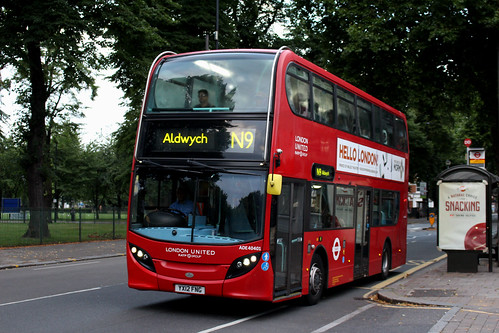
RARE: Enviro 400 on Route N9
London United ADE40401 on Route N9, Turnham Green Church, 27/07/2017
(© Aubrey Morandarte)

ADE40401 started out as ADE1 with London United, ordered for the 81/120/222 contracts as London United's first deckers under RATP ownership. These buses, based at Hounslow (AV) ended up being one of only two batches of diesel Enviro 400 ordered by London United. These buses rarely strayed outside the daytime routes, and the 222 night service when it was introduced. Until 2017, when the ADEs started to run on the N9 for the latter part of that year only. During this time, the 120 and 222 was earmarked to move to Metroline, and allocations seemed to have relaxed. This bus then moved to Edgware (BT) for Route 258, when that route was gained on 30th September 2017. This bus is currently still at London Sovereign for the 142/258.

Route N9 was introduced in 1992, running between Trafalgar Square and Kingston, via Ham or Teddington, replacing the southern end of the N92 and the full route of the N65. Originally, Stamford Brook (V) operated the route, but moved to Hounslow (AV) in 1994. In 1997, the route was extended to Aldwych in order to correspond with the day 9. It also saw the withdrawal of the Ham services, with a night service returning to Ham with the introduction of the N65 in 2002. September 2001 saw the N9 be rerouted at Hammersmith to run to Heathrow Airport Central, replacing the N97 which had ran to Heathrow since 1978. This led to the blinds of the then-new Volvo B7TLs allocated to the route to have all except one via point (Hammersmith) blanked out on the blind. Thus the blinds had less information than the subsequent blind sets the buses received.

The opening of Heathrow Terminal 5 saw the route extended there in 2008. With the extension, the route had journeys on Sunday mornings finishing at Heathrow Terminal 5 at 0815hrs, which excluding the temporary N5/N20 Northern Line replacement services, were the latest finishing journeys of all night routes in London. By 2012, the Volvo B7TLs had been replaced by Scania OmniCity double deckers (SP) from Route 111, which was the solid allocation on the N9 until 2017, and continues to be the allocation until the 25th January 2019.

From the 26th January 2019, the route will return to Stamford Brook (V), losing the bulk of early journeys and late journeys and the N9 no longer will have journeys past 0700 on any day. LT class buses from the 9 allocation will also be used on the route. The route will finally start interworking with the day 9, as the losses of routes 120, 222 at Hounslow (AV), H32/H37 gaining a weekend night service as well as the frequency decrease of the N9 means that Hounslow has enough room to store their buses overnight, hence the N9 can move to Stamford Brook (V).

Post by Aubrey Morandarte

All rights reserved © WLTMTB 2019

31/12/2018

Picture Archive Post 78 & Happy New Year!

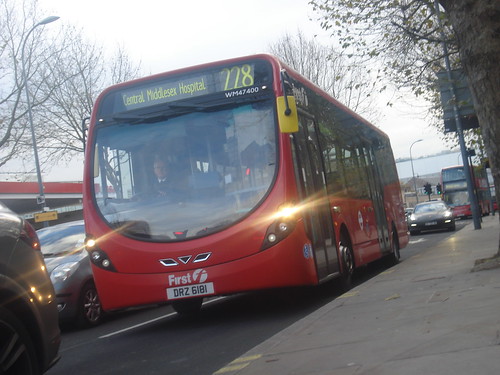
First London WM47400 on Route 228, White City
First London WM47400 on Route 228, White City, 01/12/12
(© Aubrey Morandarte)

Route 228 is one of the newest bus routes in London, starting in January 2009 with Enviro 200s from Willesden Junction (WJ). Operated by First Centrewest until June 2013, it moved to Metroline West thereafter. It was introduced to increase connectivity with the new Westfield Shopping Centre. It is the only bus service which travels through the shopping complex, and serves the Old Oak Common rail depots, providing a then new link between East Acton and Willesden Junction. This area soon will be developed as part of the Old Oak Common regeneration scheme.
From 19th January 2019, this scene will be the allocation, as new Streetlites will be the allocation for Route 228, as Tower Transit will take over operation from Westbourne Park (X).

DRZ6181 started out as a First London demonstrator of the then new Wrightbus Streetlite. It originally ran on Route 187, 226, 228 from Willesden Junction (WJ). Delivered in December 2011, it was initially supposed to be delivered to Lea Interchange to run on the 236. It ran in London service for just less than two years, returning back to the lessors in February 2013, just before the transfer of WJ to Metroline in June 2013.

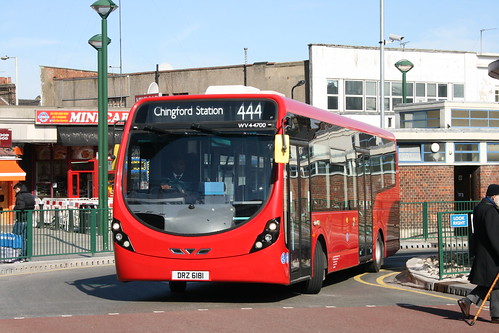
The bus then resurfaced in March 2015, as a spare bus for Route 444 ironically at Lea Interchange (LI/HO). However, as First left London in 2013, it was operated by Tower Transit, as seen below. It lasted in service until February 2018, where it has been replaced as a spare bus. Ironically, it has spent some service time on Route 236, the original route the bus was intended for!

Tower Transit WV44700 on Route 444, Turnpike Lane Station
Tower Transit WV44700 on Route 444, Turnpike Lane Station, 07/03/2015
(© Aubrey Morandarte)

2018 has been a fairly decent year, covering London mainly this year. Unfortunately, the author is currently medically unable to cover transport changes until March 2019, but the time will be spent finishing posts which were incomplete in 2018. Thank you all, and we shall return stronger in 2019!

Happy New Year from the WLTMTB team!

Post by Aubrey Morandarte

All rights reserved © WLTMTB 2018-2019

20/11/2018

Picture Archive Post 77

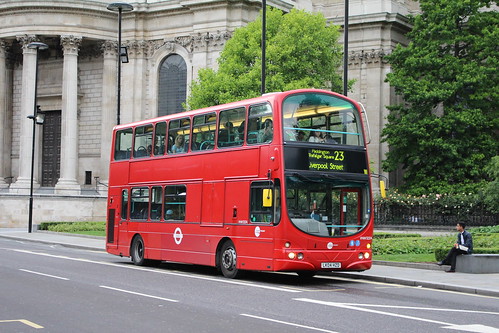
Tower Transit VNW32374 on Route 23, St Paul's
Tower Transit VNW32374 on Route 23, St Paul's, 13/06/2016
© Aubrey Morandarte

Route 23 started as a route to replace the western end of Route 15 as part of the major Central London changes in 1992. Ironically, most of the route was covered by a previous iteration of Route 23 from 1981 to 1985. Running between Westbourne Park (Mon-Sat)/Ladbroke Grove (Sun) and Aldwych (weekends)/Liverpool Street (weekdays), it used Routemasters from Westbourne Park (X) in the Centrewest sector. Sundays were one person operated with MCW Metrobuses. The one person operated part was increased to evenings too in 1993, and converted to low-floor operation in 1999 when the 18 was converted to low-floor with Dennis Trident/Plaxton Presidents. 15th January 2003 saw the route converted to full low-floor operation with Transbus Trident/ALX400s, with the whole route being operated daily. The night service was integrated into the 23 in 2004. 2008 saw new Enviro 400s introduced to the route, although they were soon off in 2012 by newer Enviro 400s and hybrid Enviro 400Hs, as the older buses became part of the allocation of the 607.
22nd June 2013 saw the route transfer to Tower Transit as this part of First Centrewest was sold to Transit Systems.

30th September 2017 saw the route withdrawn between Aldwych and Liverpool Street due to the first stage of Central London cuts. 24th November 2018 will see the route withdrawn further to Marble Arch, instead rerouted to "replace" the western end of Route 10. However, as the western end of the 10 is mostly paralleled by the 9, it has led to the 23 being relegated to a linking route, as the 27 and 295 covers a more direct routing of where the 23 goes. This means it is an awkward C shaped route which only covers shorter links, and being the link to Marble Arch to Kensington & Hammersmith.

VNW32374 was ordered for the 28, 31 and 328 as part of their double decker conversion in 2004, allocated to Westbourne Park (X). It moved to Atlas Road (AS) in 2011 along with the routes due to the temporary shrinking of Westbourne Park for Crossrail works. It returned back to Westbourne Park in May and June 2016 for its final days in London service. The bus was then retired from London service, moving within the Transit Systems group to Whippet in Cambridgeshire.

Post by Aubrey Morandarte

All rights reserved © WLTMTB 2018

Released: 31/12/2018

20/09/2018

Picture Archive Post 75

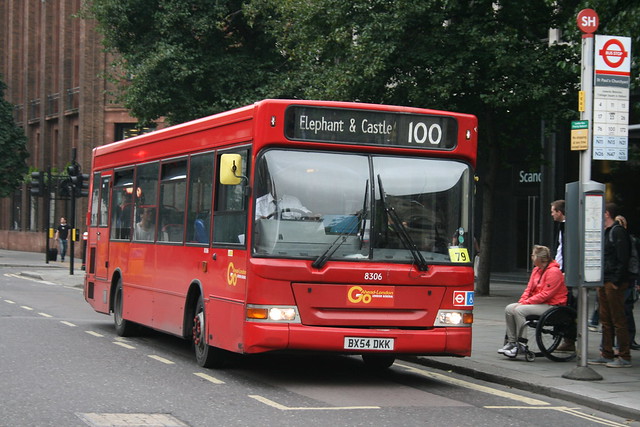
London General 8306 on Route 100, St Paul's
London General 8306 on Route 100, St Paul's, 20/09/2014
(© Aubrey Morandarte)

8306 was originally Travel London's DP306, ordered for Route 100 in September 2004 from their then newest base of Walworth (WL). It stayed with the 100, even with the contract moving to London General (Go-Ahead London). As their Enviro 200s were not delivered for the start of the 100 contract, they leased the existing buses from Abellio London. Based at Mandela Way (MW), this arrangement lasted until the new buses entered service. Once this had taken place, it was withdrawn from Abellio London service in May 2015. It is now found in the West Midlands, operating for Thandi.

This bus is seen at a place that it no longer serves, as the 100 was truncated to Barbican, London Wall/Museum of London.
This however, is still longer than the original route, having run only between Liverpool Street and Shadwell upon introduction in June 1989. Under sectorisation, it moved from Clapton (CT) to Bow (BW) in 1990, thus falling under East London (and eventually Stagecoach East London). 1992 saw the route move to Stratford (SD), and 1998 saw new Dennis Dart SLFs for the route. 18th September 1999 saw the route be extended to its longest extent, Elephant & Castle to Shadwell. Travel London, then reentering the London tendering market for the second time, gained the 100 off Stagecoach in September 2004, with the Darts as seen above. New Enviro 200s arrived in 2010 in order to supplement the Darts. After the loss of the 100 to Go-Ahead on September 2014, the allocation temporarily moved to cover the lack of new Enviro 200s. Once those new buses entered service, the ex-Abellio buses returned to their owner. The 100 was truncated to Barbican on 8th April 2017, replaced by the 388 being extended to Elephant & Castle.

Ironically, under the future TfL Central London cuts, the 388 will be truncated to Finsbury Circus, thus the 100 will return to St Paul's. Considering the 100 was cut back in 2017, it seems that planners are messing heavily with financial implications for the 100 contract, as well as the general public. Although, extending the 100 may not require more than 1 extra bus, as it is a very short distance between Barbican and St Paul's.

Post by Aubrey.

All rights reserved © WLTMTB 2018

20/08/2018

Picture Archive Post 74 + The Issue of the Bus Cuts in Central London

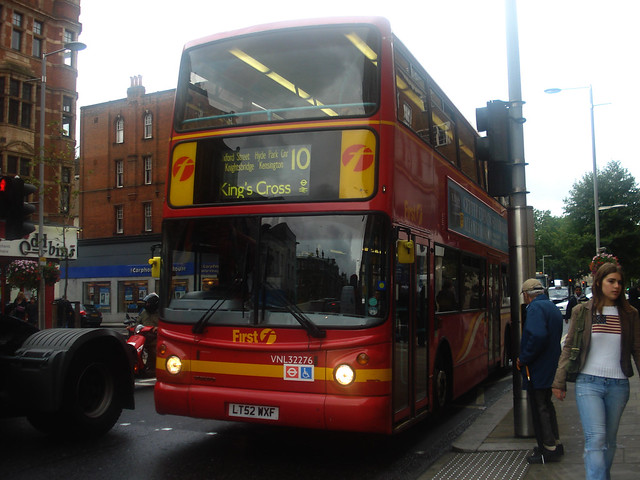
First London VNL32276 on Route 10, Kensington High Street, 01/09/2008
(© Aubrey)

VNL32276 is a Volvo B7TL/ALX400 ordered for the truncated Route 10 back in January 2003. The bus had a relatively short London career, being allocated to the 10 throughout. Other than being initially based at Wood Lane due to Westbourne Park being full when the 10 was gained, the bus had stayed at Westbourne Park (X) until the 10 was regained by London United. It also ran on other Westbourne Park based decker bus routes, including the 7, 23, 28, 31 and 328. Once the 10 was lost, the bus moved to Doncaster for use on First routes there, where it still is currently.

As the 10 has been covered in an earlier Picture Archive Post, this post is also another opinion piece, this time to do with the larger reduction of bus routes.

The current issue.

With the advent of the leaked Transport for London proposed Central London bus cuts, the current cuts already happening, and the endless frequency reductions, it seems the cuts to buses seem endless. Although there is a large funding black hole caused by previous Chancellor, George Osbourne, there surely must be better ways of dealing with it than just reducing the current network.

There is excess capacity within Central London, but the issue is that buses are unattractive within Central London. Congestion within the centre has only gotten worse over the years, making people move away from buses for short distance travel. If we reduce the current public transport infrastructure, then this makes public transport less attractive than before. People can point to Crossrail and the Northern Line extension as a diversion tactic away from the real fact that people are being drawn away from public transport currently. These schemes will bring more people in, but these things are in a few years, and the issue is pressing right now.

Buses within Central London also suffer from too little stand space. Many of the roads which are of over capacity are "last/first mile" reaches to parts of the route which are more popular. This includes the inner-Central London stretches of some of the mooted buses to be cut, including 14, 22, 53, 171, 172 etc. The bus network within Central London is designed to be interlinked. Most of the proposed changes are designed to remove these "interlinked" sections, where buses from the east/west and north/south meet. Inevitably, with this type of network, it leads to the system having many empty buses directly in the centre. This can be viewed as inefficient, and some cuts can be made.

However, making large scale cuts (some of which ironically negate other cuts which were made a few years ago) can lead to a more patchwork network across Central London, therefore TfL need to be careful about what they cut. Another issue within inner London is the lack of bus stand space with the amount of increased buses over the years. It has led to severely awkward stands at the back of Oxford Street to serve Oxford Circus, and the proposal of the 27 to stand away from Hammersmith Bus Station, at Hammersmith Grove due to sheer lack of stand space at the main area of Hammersmith. Elephant and Castle is going to be turned into a massive array of bus stops which should really be a large smooth bus station, with the sheer amount of bus routes terminating at the area.

Buses has been noted to have a severe decrease of passengers over more recent times. This is a serious issue, and the more unattractive the first and last mile transport is, the more likely people will move to Uber, Addison Lee and other similar minicab services. The two mentioned have had previous public relations disasters recently, and it seems we are moving towards a wrong direction with transport within London.

At night, this leads to severe traffic nightmares throughout Central London as long queues around midnight-1am are full of taxis and minicabs plying for trade, simply because bus travel is not as attractive at night anymore. Night Tube has moved people underground, but there are some places where night buses need to improve, and most certainly not be cut. As London grows as a city, we should have more people on public transport, not less.

What seems to be currently done.

Currently, Transport for London are attempting to make public transport more attractive by advertising their own lines...on their own stations. If people are already at the station, then why would you advertise the exact service they are getting on. Meanwhile, the cycle superhighways being built compromises the existing bus network by squeezing existing bus and other traffic into smaller road space. Special cycle lanes do encourage cycling to work, which can only be good. To address the bus problem, they are cutting services with frequency reductions across the board. London is supposed to have a world class transport system, but surely it could be better. No money is being spent for bus infrastructure within Central London. New buses are as part and parcel of contracting bus services, but there are many bus routes which are being awarded to different companies with refurbished existing buses.

How do we actually make buses attractive again?

Any action required does mean that we need to spend money. Making bus travel attractive will bring more people back to buses.

Making it harder for other vehicles to access certain parts of London will 'force' people to take public transport. This could be done by actually making the Congestion Charge a full congestion charge. When the charge was introduced, it was a flat rate for all vehicles, which was discounted if you lived within the area or just on the outskirts of the zone (understandable, as it's basically charging you to drive no matter what if you live there). Recently, incentives have been made for vehicles with low emissions to be exempt to the congestion charge, completely negating the exact reason why the congestion charge exist. Personally, I don't care if your car is a new electric vehicle, or a 1993 diesel, if you are in a car, you could easily make that journey bus or train. Yes, there are some circumstances where public transport may be difficult to use (e.g. moving house), but most of these exemptions are one-offs, or costs that could be negotiated to provide better value for the trade/companies. Long distance travel can pass along the ring roads which exist solely for through traffic to by-pass Central London. Embankment is a very notable road which is used as a thoroughfare to keep vehicles away from the smaller Central London streets. However, with the Cycle Superhighway, the road has narrowed to the point vehicles are ironically using the more central roads to circumnavigate the Embankment.

Making bus priority measures more prominent, and longer bus lanes, forcing other traffic onto dedicated roads (e.g. Embankment). This allows bus journeys to be faster, thus journey times are faster. This means buses can be removed to retain the same frequency, with those buses being spent on outer London services.

Increasing fares. Yes, this may seem detrimental in the short term, but the £1.50 fare was initially envisaged as a fare for one sole bus. Now, you can travel on more buses for the same fare, thus increasing the value of that fare. However, with the hopper fare, it means that the fare vastly underpays the actual value of the journey. This is one of the primary reasons why there is such an exaggerated black hole in the funding for Transport for London. Once the Mayoral role has changed over to whomever the Conservative candidate is once Khan's reign is over, this unfortunately will be one of the inevitable results. Rising fares does make mobility of people difficult though, and as there are a lack of wage rises, I highly doubt this would be popular as people would need to spend more to travel.

Cutting some services which are easily duplicated is still required. For example, the extension of the 88 over the C2 route cuts minimal links, but covers the whole C2 route in the process in any case. However, the Hopper is now being made a "fits-all" solution to all broken links, and consultations time and time again all cry like as if this is the solution to the world's needs! However, if the journey times are so slow, it can ironically negate the hopper if it takes more than 70 minutes to make the connection itself.

If one is to cut routes, infrastructure and timetables need to be coordinated so that there are very small times for connections during the daytime, and that changes are convenient. Building a bus station at Elephant and Castle would be no easy task, but Vauxhall just shows that a large bus station could improve interchange, especially between the disconnected rail stations. The sheer amount of bus routes being changed around Elephant and Castle over the years, with more terminating routes could lead to an issue of stand space in the area. One could certainly go all White City-like and put the bus stands in the undercroft of a large development, but the stand space exists in one area, which is the main thing.

Transport for London have no easy solution out of this, but they've certainly shot themselves in the foot with their own errors of funding.

The full extent of the cuts can be seen here: https://853london.com/2018/08/15/tfl-plans-permanent-cutbacks-for-routes-53-171-and-172-in-huge-bus-axe-scheme/

The views of this post do not reflect the views of the rest of the WLTM Transport Blog, and are solely the personal views of the author.

Post by Aubrey.
All rights reserved © WLTMTB 2018

28/07/2018

Picture Archive Post 73

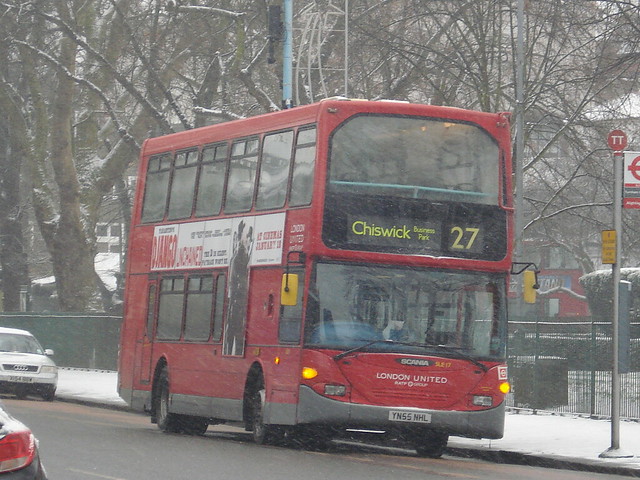
London United SLE17 on Route 27, Turnham Green, 20/01/2013
(© Aubrey)

A tad late in terms of Picture Archive posts, this one is also a tad different. As route 27 already has been covered in Picture Archive, the route section of the post will be dedicated to an issue regarding the 27, amongst general TfL policy over recent years.

The bus (SLE17) was one of the initial Scania N94UD/East Lancs OmniDekka buses ordered for the 267 initially in early 2006. Based at Fulwell (FW), these were the first new double deckers ordered by London United since TA346 in 2003. In early 2013, the new hybrid ADL Enviro 400H was ordered for Route 27, moving the (slightly) newer SLEs to Fulwell for the 267, and the older SLEs were sent to Stamford Brook (V) to see out their days on the 27. This particular example ended up at Thamesdown Transport, in Swindon.

The newest section of Route 27, between Chiswick Business Park and Hammersmith (Ravenscourt Park during the day) is under threat due to Transport for London cuts. Although this may seem to be a small cut, the section is the one mostly used by the author to travel to places for coverage for the transport blog. Also, it would sever an area close to Central London (Zone 2/3) a direct bus link into Central London. A replacement 440 rerouting would sever Chiswick Park Tube Station from a direct bus link, and eliminate some local links within Chiswick and the Bollo Lane area. TfL are, yet again, marketing the "Hopper" fare as a god send, when it really is not.
Continually being forced to change buses only means that people will be less attracted to travelling by bus. The night bus frequency cuts only helped taxi firms. In an age where we need to have people travelling more by public transport, frequency cuts, slower travel times and bus route section cuts are only making people force onto other modes of transport, which includes the rise of private transport. This ironically increases the amount of vehicles on the road, causing travel times to decrease further. The mobility of the citizens of a city by public transport determines the accessibility of jobs, and therefore income and economic impact. If the poorer citizens are being affected by poor transport, they are less able to get to jobs.

Transport for London having their government funding cut has caused cuts across the board throughout the bus network. The situation has been exaggerated by the freezing of single fares by the incumbent Mayor of London.

Until 12th August 2018, there is a consultation that is open which determines the future of Route 27 and 440, including their routing through Chiswick. However, this is more than just about the future of these routes. Transport for London want to cut more services, either by stealth (frequency cuts) or outright. This needs to be stopped before we go too far on the decline back to the 1980s.
Link: https://consultations.tfl.gov.uk/buses/routes-27-and-440/

20/06/2018

Picture Archive Post 72

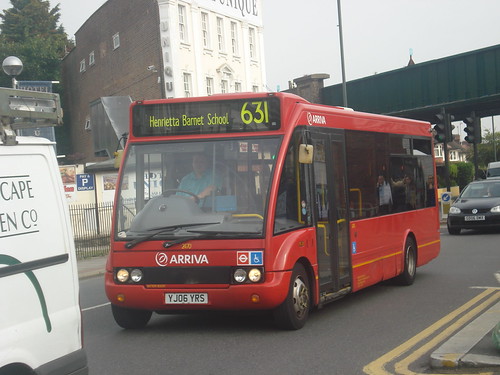
Arriva Shires 2470 on Route 631, Golders Green, 20/06/2013
(© Aubrey)

Route 631 started out as Route H1 as a school route for Henrietta Barnett School, in Hampstead Garden Village. Route H1 started on 4th January 1993 as a replacement/supplement to the H2 school journeys. As a minibus route, due to the tight roads around the Hampstead Garden Village area, the route was always required to have small, narrow buses. The route started out with R & I Coaches from North Acton (NA). Through MTL ownership, the route eventually ended up in Metroline's hands. September 2000 saw the route move to Harlesden (HR). June 2003 saw the route move to North Wembley (NW), before settling on Perivale (PV) in September 2004. New Optare Solo Slimlines replaced the MCW Metroriders on the routes from June 2005. Those buses however only lasted 1 year, as Arriva the Shires took over the routes, with new Optare Solo Slimlines, including the example shown (2470). The routes ran from Garston (GR).

Route H1 was renumbered 631 to be in line with other school day only routes on 18th May 2013.

Under the streamlining of the London operations of Arriva, the route passed to Arriva London, and the bus was re-numbered OS71. Metroline took over the route on 9th June 2018, running the routes from Cricklewood (W) using the existing buses temporarily, until new Optare SoloSRs are delivered.

22/05/2018

Picture Archive Post 71

Docklands Buses SO2 on Route 474, London City Airport
Docklands Buses SO2 on Route 474, London City Airport, 20/04/2013
© Aubrey

Route 474 started as a route replacing the 69 between Silvertown and North Woolwich, as well as provide new links towards across Silvertown. Starting on 1st May 1999, the route was operated initially by Blue Triangle using Dennis Trident/East Lancs Lolyne buses from Rainham Ferry Lane (FL/BE). From 17th December 2005, the route was diverted to London City Airport to replace Route 69 between Canning Town and London City Airport. Also, an extension to Manor Park Station supplemented Route 101 between Cyprus and Manor Park, as well as replace the 101 to North Woolwich (which was diverted to Gallions Reach). This required additional buses, so some Scania N94UD/East Lancs OmniCity buses were ordered (as seen).
Go-Ahead Group took over the then independent Blue Triangle on 29th June 2007, and soon, a multitude of different cascaded buses started to appear on the 474, replacing the Tridents. This included buses from London General/Central and Metrobus. 3rd November 2007 saw a night service introduced to the route, and the route transferring to Docklands Buses in Silvertown (SI).
During 2011, the route was allocated a Volvo B9TL/MCV DD103, but eventually, the allocation from 2011 tended to be the Volvo B9TL/Wright Gemini 2. When River Road (RR) opened on 30th April 2016, the route moved back to Blue Triangle at River Road.

As of 5th May 2018, the route is now with Stagecoach London at West Ham (WH), using existing Enviro 400s and Tridents temporarily, until new hybrid double deckers replace them.

SO2 started out as a Blue Triangle bus, for the 474 extension in late 2005. Once the bus had moved with the 474 to Docklands Buses (SI), the bus was also used on the 425 and 541. It led an uneventful life on the Docklands Buses routes until 17th February 2016, when the bus was withdrawn. It was later sold to Midland Classic for use on their routes in Burton-upon-Trent, where it is today as their 56.

As some of you have may noticed, we have not been very active over the past two months. This is mainly because we have very busy lives, especially as I'm doing my final year project at university. We have been unavailable to cover and do posts, so we thoroughly apologise. Things will be getting back to normal as soon as possible.
Thank you all.

Post by Aubrey
All rights reserved © WLTMTB 2018
20/03/2018

Picture Archive Post 69

Last Coventry BendiBus
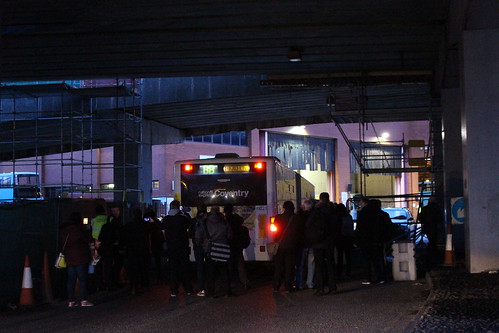
The last Coventry BendiBus, for the last time. (20/03/2018)
(© Aubrey Morandarte)

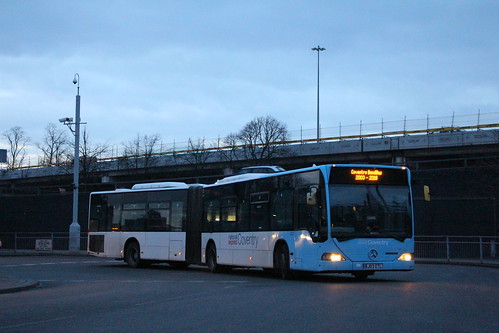
On the 20th March 2018, Coventry saw its last articulated bus, as 6021 rolled into Coventry Garage at about 6:30pm after doing a run on Route 4.

Articulated buses started out in May 2003, with these Citaros running then route 27 between Coventry Station and Walsgrave, University Hospital. Older Mercedes-Benz O405GN transferred from Travel West Midlands also ran on the 21 from 2004. Those buses had ran on the 67 in Birmingham from 1999, and were replaced by Scania N94UAs. In 2011, the older bendy buses were replaced with Enviro 400s on Route 21, leaving the Citaros to continue running on the 27. In 2012, the 27 was rerouted at Coventry City Centre to run to Arena Park, and renumbered 4.

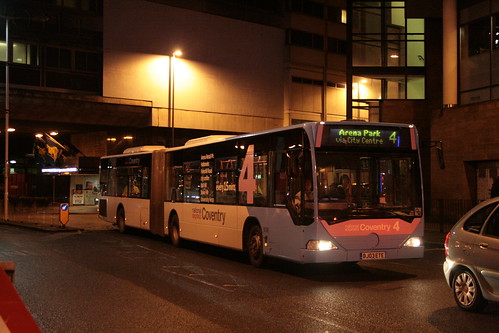
Bendy at Night
NX Coventry 6018 on Route 4, Pool Meadow, 30/10/2015
(© Aubrey Morandarte)

The buses soon gained National Express Coventry names and continued on the branded Route 4 until 2018, when the last "bendibus" ran on the 4. Replacement of these buses are existing double deckers from within the National Express West Midlands umbrella, most of which are ironically older than the Citaros.

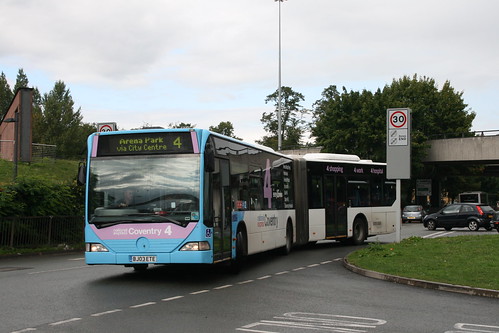
Round A Bend
NX Coventry 6018 on Route 4, Pool Meadow, 02/09/2015
(© Aubrey Morandarte)

6021 itself started out as a Travel West Midlands bus, operating on the 67. However, it moved along with the O405GN2s to Coventry in 2004 where it ran mainly on the 21, then the 27/4. It will be sold for scrap.

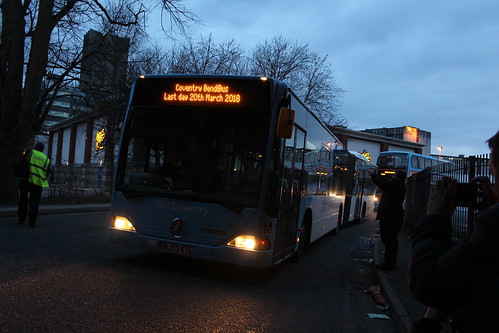
NX Coventry 6021, Coventry Pool Meadow
6021 entering Coventry Garage for the last time.
(© Aubrey Morandarte)

Last Coventry BendiBus
A load of transport enthusiasts film/take photos of 6021 as it enters the bus garage.
(© Aubrey Morandarte)

Post by Aubrey Morandarte
All rights reserved © WLTMTB 2018
20/02/2018

Picture Archive Post 68

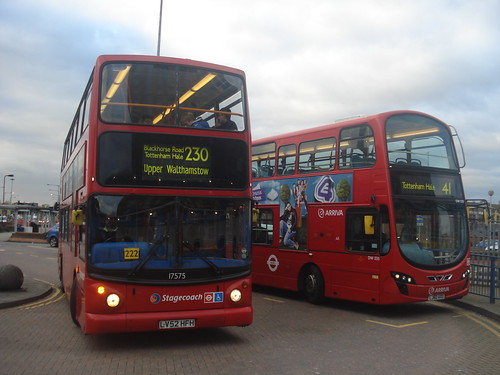
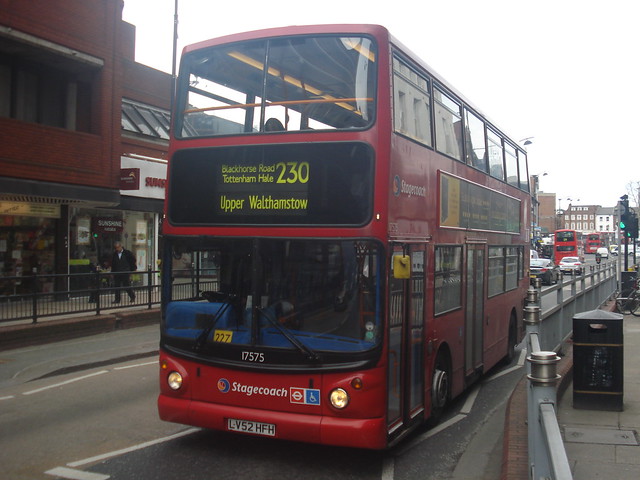
Stagecoach London 17575 (Route 230), Arriva London DW335 (Route 41), Tottenham Hale
Stagecoach London 17575 on Route 230 & Arriva London DW335 on Route 41, Tottenham Hale, 02/02/2013
(© Aubrey Morandarte)

The area of Tottenham Hale has changed over the past 5 years, and is still undergoing change. The bus station layout has changed most notably so far. The photo was taken with the old layout of the bus station.

Route 230 is one of the very few double decker routes with a hail & ride section, with the section at Upper Walthamstow being hail & ride. Introduced in 1973 between Manor House and Stratford with Routemasters from Leyton Garage (T), the route stayed at Leyton Garage throughout its life at London Transport, London Forest, East London and Stagecoach. In 1981, the route was shortened to Whipps Cross-Manor House, before later extended to Finsbury Park and Leytonstone in 1982. In 1981, the route was also converted to OPO, with Leyland Nationals. 1987 saw the introduction of Titans, and the route diverted to run Wood Green-Leytonstone. Sectorisation saw the route fall to London Forest initially, but as London Forest collapsed, Leyton Garage and the route moved to East London (later Stagecoach). The current route came about in 1996 when Darts (initially Alexander Dash/Dennis Dart, then Alexander ALX200/Dennis Dart SLF) arrived on the route. After trees were chopped by 2004, Dennis Tridents as seen plyed the 230 until 22nd June 2013. Arriva London took the 230 over from Tottenham (AR) with new VDL DB300/Wright Pulsar Gemini 2s, and thus this is the route today.

Route 41 gained its current route back in 1937, when it was extended from Crouch End to Archway. Having been based at Tottenham (AR) for most of its life, it has mainly seen weekday route extensions to Dagenham Dock (1941-1942, daily), Ilford (1942-1960 during peaks), Stratford (1960), Victoria & Albert Docks (1961-1968), Ferry Lane Estate (1981) and Highgate Village (1984-1985). By 1989, the route was OPO, based at Tottenham (AR), Wood Green (WN), and Holloway (HT). Under sectorisation thus, it ran from Leaside Buses and London Northern. In 1994, the route was tendered to MTL London Suburban Bus from Edmonton (ED), using Leyland Titans. 1996 saw the route go back to Cowie Leaside Buses with Metrobuses from Wood Green, before moving to Tottenham in 1998. 2001 saw the low floor conversion, with introduction of the DAF DB250LF/ALX400 on the 41. 2013 saw these buses be replaced by the VDL DB300/Wright Pulsar Gemini 2s.

Stagecoach 17575 started out as TAS574 at Catford (TL), before being renumbered 1575s. It transferred to Macquarie Bank (ELBG) in 2006. In 2009, the bus was loaned to Metrobus for the 75 as their Scania N230UDs were late. July 2009 saw this bus move to Leyton (T), as seen in the photo above. In July 2014, the bus was withdrawn from London service and moved to Stagecoach Scotland West for the Commonwealth Games. After the event was done, it moved to Manchester as reserve, then Merseyside for Merseyrail replacement services. In May 2015, the bus was deroofed for sightseeing purposes, and is now at Stratford-upon-Avon for sightseeing purposes.

Arriva DW335, a significantly newer vehicle, was at Tottenham (AR) from introduction to  9th December 2016, when the bus thereafter moved to Edmonton (E) for the 349 mainly. . March 2017 saw the bus move to Brixton (BN) for mainly the 50 and 319, until September 2017. October and November 2017 saw the bus go to Wood Green (WN) mainly for the 144 and 221. After a few months, it reappeared on the 14th February 2018, at Edmonton (E), where it is now.

20/01/2018

Picture Archive Post 67

Finally, a night bus service to Terminal 4.
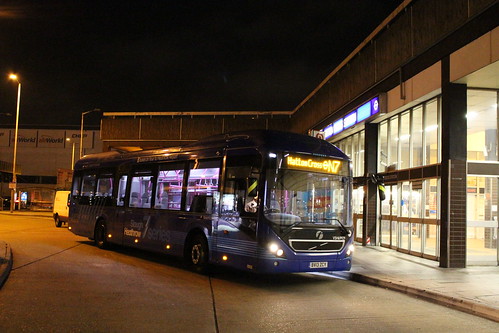
First Berkshire VSH69929 on Route N7, Hatton Cross Station, 28/09/2016
(© Aubrey Morandarte)

Route N7 began after the "rationalisation" of the First Berkshire network, splitting the Heathrow routes to a core route to Slough, with the other half of the routes being localised to terminate at Slough. Night service by First Berkshire from Slough to Heathrow began on 5th September 2015, when the 75 (to Heathrow Central via Langley Harrow Market) and 78 (to Heathrow Terminal 5 via Trelawney Avenue) had an added hourly night service. This stayed as far as 24th September 2016, when the routes were split. The N7 was formed as a night service, which ran every 30 minutes Slough-Heathrow Terminal 5, before running alternately to Heathrow Central and Hatton Cross via Terminal 4. The part between Hatton Cross and Heathrow Terminal 4 only lasted about 10 nights, being withdrawn on 3rd October 2016. Passenger numbers between Heathrow Terminal 4 and Hatton Cross were so low, it is likely that the author was the only passenger ever to Hatton Cross on the N7. The N7 thus continued as Slough-Heathrow Central/Terminal 4 until the morning of the 19th January 2018. Further cuts on First Berkshire has caused the withdrawal of the N7 service, with a few 7 journeys replacing the latest N7 journeys. Thus ends the short-lived attempt to give Heathrow's forgotten terminal a night bus service.
Yes, somehow, Transport for London don't give Heathrow Terminal 4 a night bus service, yet commercial First Berkshire managed it for a couple of years.

VSH69929 is one of a few Volvo 7900s in the UK, and harks back to a more successful 7series era. 2013 was when First Berkshire obtained these buses to upgrade the 7series routes, then consisting of the 71, 75, 76, 77 and 78. With the Green Bus Grant partly funding these buses, this bus was part of a batch of 10 initial hybrid buses for Berkshire. A further 5 buses were ordered in 2014, thus 15 Volvo 7900s now are supposed to form the whole allocation of the 7. When these were ordered, they supplemented and replaced part of the large Citaro fleet for the 7series. Heathrow-Slough via Langley at the time was 8bph. After the most recent cuts, the service has been reduced to 4bph.
These buses still show the erroneous 8 buses per hour figure, as these buses have not been rebranded to show the current situation. They are still at Slough Garage though, although with the cuts to First's services, one can only worry what could happen in the future.

Post by Aubrey Morandarte
All rights reserved © WLTMTB 2018
20/12/2017

Picture Archive Post 66

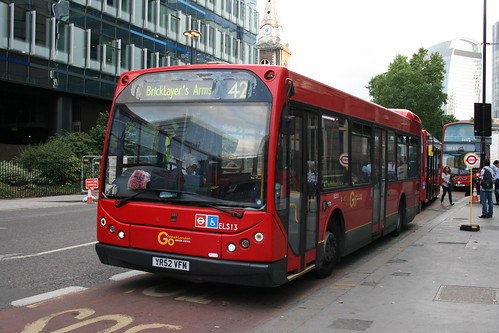
London General ELS13 on Route 42, Aldgate, 08/07/2015
(© Aubrey)

ELS13 is a Scania N94UB/East Lancs OmniTown ordered in early 2002 for the 42 by Durham Travel Services (London Easylink). For most of its life so far, it has been on the 42. This route was gained from Connex/Limebourne back in January 2002. Only a few months later, London Easylink went into liquidation, so Transport for London took over the work of London Easylink as East Thames Buses on 21st August 2002. Once the impounded buses were taken over by TfL as East Thames Buses, these buses stayed with ETB initially at Ash Grove Garage (AG). With the 2005 opening of Mandela Way (MA), the bus and route moved there. Go-Ahead purchased East Thames Buses in 2009, thus the bus and route moved to GAL. These buses gained skirts, just as most other buses were losing theirs. This bus ran on the 42 until 23rd December 2015. Afterwards, the bus was sold on to Trustybus (Galleon Travel) near Harlow. Now, as TB VFM (HXZ9926), this bus runs on Trustybus routes in and around Harlow.

Route 42 itself started out as a cross-London trunk route, running at maximum length from Turnpike Lane to Camberwell Green in the 1930s. Shortened to Aldgate-Camberwell Green from Old Kent Road and Camberwell garages in 1939 due to WWII, the route mainly stuck to the same routing until 1994. From 1951 until 1985, the 42 was with Camberwell Garage. Extensions to Herne Hill and Norwood Garage on Sundays and garage journeys happened in the 1950s, until 1966. RTLs ran on the route from 1951-1966, before being replaced with RTs. To convert the route to OPO, the bus route was converted to single decker with MBs (AEC Merlin), before re-conversion back to double decker with the DMS (Daimler Fleetline) in 1973. 1979 saw a re-conversion back to single decker with the SMS (AEC Swift), lasting less than a year before returning to DMSs. Leyland Titans (T) ran the route between 1980 and 1987, before the first part of privatisation of LT took place, with initial tenders of bus routes coming out in 1987.
London Country South East (formerly NBC London Country, ironically stemmed from the LT country division) won the 42 on tender with Leyland Nationals at a base initially at Catford. The base then moved to Victoria (Battersea Coach Park) in 1987 and Bricklayers Arms in 1989. LCSE was re-branded as Kentish Bus in 1987, and thus the route was operated by Kentish Bus. 1990 saw the route gradually move to Leyton, and gain Leyland Olympian operation on weekends. A full move to Leyton in December 1990 saw the route convert to MCW Metroriders. The route was extended in 1994 to Liverpool Street Station, and new Dennis Dart/Northern Counties Paladin buses were introduced in 1994. April 1997 saw the route move to Limebourne, from Battersea (QB). New Dennis Dart SLF/Plaxton Pointer I were put onto the route, and the route was extended to Denmark Hill. On October 1998, Limebourne went into receivership, and for a time suspended operations. Eventually, the management re-established Limebourne, and the route ran with different Dennis Dart SLF/UVG buses ordered new to replace leased buses in early 1999. 2001 saw the purchase of Limebourne by Connex, and thus the route was run by Connex for a year, before it was moved to Durham Travel Services (London Easylink). London Easylink ran the 42 at Old Kent Road for 8 months, before they went bust. East Thames Buses used new ELSs from London Easylink to run the 42 at Ash Grove (AG) initially, before moving to Mandela Way (MA) in 2005. 2009 saw East Thames Buses be sold off from TfL to Go-Ahead London (London General). The route moved to Camberwell (Q) in 2010, before moving to Mandela Way (MW) in 2012, and returning to Camberwell in 2014, where it is today.
On 1st October 2016, the 42 was extended from Denmark Hill to East Dulwich Sainsbury's, and is now run with Volvo B5LH/MCV EvoSetis from Camberwell Garage.

Post by Aubrey Morandarte
All rights reserved © WLTMTB 2017

20/11/2017

Picture Archive Post 65

Arriva-TGM 1632 on Route E10, Ealing Broadway Haven Green
Arriva-TGM 1632 on Route E10, Ealing Broadway, 26/09/2015
(© Aubrey)

As Route E10 turns to London United on the 9th December 2017, the route has undergone only one operator change dictated by contract. All other times has been due to novation, or the operator being bought out.

The route was created in 1997 to replace the Smith's Farm spur of Route E9, and part of Route E4, running between Smiths Farm and Ealing Broadway. Based at Greenford (G) with Centrewest (later First), the new route used Mercedes Benz 811D minibuses. A low floor conversion in 2001 gained it 8.8m Dennis Dart/Marshall Capital (DMS) buses, and an extension to Northolt, Islip Manor. In 2002, new Route E11 replaced E10 between Greenford and Ealing, with the E10 taking a new direct route between the two places. 2009 saw the introduction of Enviro 200s to the route. The 22nd June 2013 sale of First Centrewest to (mainly) Metroline saw the route pass to Metroline West, before being lost by them to Tellings Golden-Miller on 31st May 2014. During this time, the E10 was mooted to gain an extension to Chiswick Business Park, but due to two councils not agreeing on how a bus can turn right, the 70 was extended instead. As part of the Arriva group, the Euro 6 Enviro 200s gained Arriva branding, and weirdly had Traveline stickers on them.

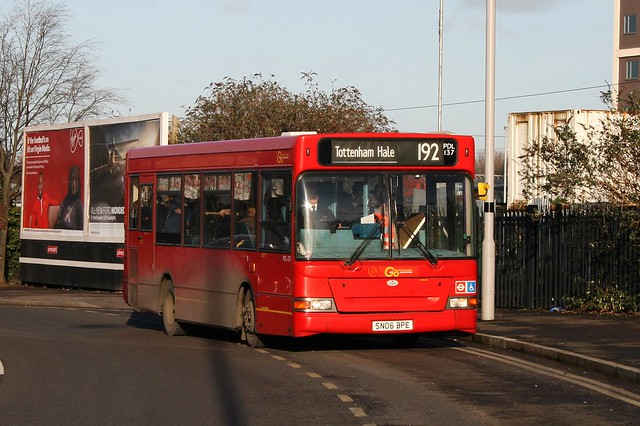
Sooner or later, the Enviros needed more than just the ordered spares, so Dartford provided extra buses, which included this example. PDL137 (1632 at this time)/SN06BPE started out as 1624 for Route 162 in Dartford (DT). In March 2011, the bus covered routes revoked from Countryliner at Guildford, after the 162 was lost to Metrobus. Due to this loss, the buses were redundant in Dartford, so they moved to Lea Valley (LV) for the 192, 318, 379, 382 and W6.

London General PDL137 on Route 192, Tottenham Hale
London General PDL137 on Route 192, Tottenham Hale, 24/01/2015
(© Aubrey)

PDL137 was one of a select few that moved to London General at Northumberland Park (NP) for use on Route 192 as the new Streetlites did not arrive until then. Once the Streetlites arrived in January-February 2015, the bus moved into store at Edmonton, before moved to Heathrow (HE) for the E10. The bus has since stayed at Heathrow, with intermittent spells at Dartford too until October 2016. Since then, the bus has been repainted and is now a training bus.

Post by Aubrey

All rights reserved © WLTMTB 2017

20/10/2017

Picture Archive Post 64

Stagecoach London 17575 on Route 230, Wood Green, 05/04/2013
Stagecoach London 17575 on Route 230, Wood Green, 05/04/2013 (© Aubrey)

Ordered for Routes 54 and 160 at Catford Garage, initially noted as TAS575, this Trident plyed routes from Catford (TL) Garage for Stagecoach Selkent. Under the national renumbering scheme, this bus became 17575s, albeit the s was dropped later on in life. When Stagecoach sold their London bus operations in June 2006, the bus initially stayed at Catford. Under Macquarie Bank ownership (East London Bus Group, Selkent), the bus went to all-red from Stagecoach swirls. When the 54 and 75 was lost to Metrobus, this bus initially moved on loan to Metrobus for two months from April 2009. This was due to their Scania N230UD/East Lancs Olympus buses being late. Only one month after returning back to Catford (TL), the bus moved to Leyton Garage (T) and thus became part of the East London sector. Thus, this bus ran routes such as the 48, 55, 56, 69, 97, 230 (as shown) and 257. In October 2010, ELBG fell back into the hands of Stagecoach, as they bought back the sector for a profit, showing that an investment bank can't run a bus operator. Its last day of London service was 9th July 2014 on the 55.
After London, the bus moved to Stagecoach Scotland West for the Commonwealth Games being held in Glasgow. In August 2014, it moved briefly to Stagecoach Manchester's reserve fleet before moving onto rail replacement on Merseyside as Merseyrail Replacement when Hamilton Square station closed. This bus was then converted to open top in 2015 and entered service as a sightseeing vehicle for Stratford-upon-Avon (Stagecoach Midlands), where it is today.

(Current) Route 230 started out as a Monday-Friday route from Leyton Garage (T) between Stratford and Manor House with Routemasters (RMs). From 1977, the route became OPO with Leyland Nationals. From 1981, the route became Finsbury Park-Whipps Cross, before only extended a year later to Leytonstone. June 1987 saw Leyland Titans re-deckering the route, with the route being diverted at Seven Sisters to Wood Green. Under sectorisation, the route initially went with Leyton Garage to London Forest. However, this sector was ill-fated, as due to a low-ball tender on Walthamstow routes in March 1991, wage cuts were proposed thus drivers went on strike. London Forest later lost the routes anyway, LBSL (later TfL) would never tender routes as a area-based package ever again and the route (along with Leyton Garage) moved to East London in November 1991. In June 1996, the route was rerouted to its present state, diverted at Whipps Cross to run to Upper Walthamstow. The route was also single-decked again, with Darts (Alexander PS, and later Alexander ALX200/Dennis Dart SLF). Only in 2004, the route was re-converted to double decker using Tridents after trees at Upper Walthamstow were sorted. As the Upper Walthamstow section was hail & ride, the route became one of the few double decker operated hail and ride sections in the TfL area. Then, albeit overshadowed by the other changes that happened on that day, 22nd June 2013 saw the route move to Arriva London North from Tottenham (AR), with new VDL DB300/Wright Pulsar Gemini 2s, which is the current state today.

20/09/2017

Picture Archive Post 63

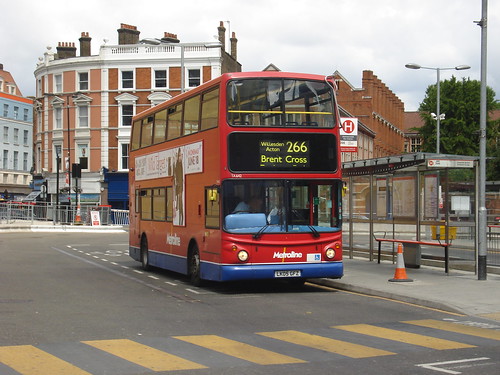
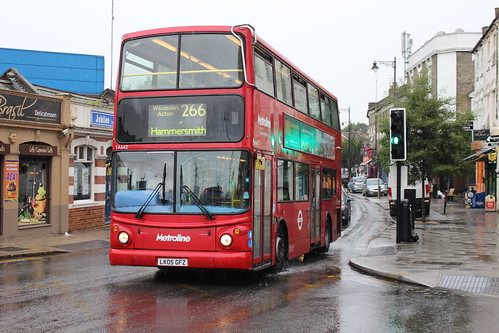
Metroline TA642 on Route 266, Hammersmith, 19/06/2010
Metroline TA642 on Route 266, Hammersmith, 19/06/2010 (© Aubrey)

Route 266 was introduced as the bus replacement of former trolleybus route 666. Running between Edgware and Hammersmith, the route ran as current 266 to Cricklewood, then as current 32 to Edgware. Introduced as part of Stage 13 of trolleybus replacement on 3rd January 1962, new Routemasters were introduced from Stonebridge Garage (SE) and Cricklewood Garage (W). A Willesden Garage (AC) allocation was added in September 1968, after Route 260A was withdrawn. In June 1970, the route was withdrawn between Edgware and Colindale (peak hours), West Hendon (weekdays) and Cricklewood Garage (weekends). June 1972 saw Hammersmith Riverside (R) gain an allocation to cover for the 255 withdrawal. 255 itself was a former trolleybus route of 655. In January 1976, Brent Cross Shopping Centre opened and Route 266 was diverted to the shopping centre on Monday-Saturday except late evenings. From October 1978, some journeys were extended in Monday-Friday peak hours via Graheme Park to Mill Hill Broadway on Monday-Friday peak hours. April 1979 saw the allocation of crewed Daimler Fleetlines (DM) on Sundays from SE. In 1980, the DMs were replaced by MCW Metrobuses (M), still crewed. 1981 saw the peak hour extensions to Mill Hill be withdrawn, and SE be closed. The SE allocation was replaced by a split Willesden and Cricklewood allocation. 1982-1985 saw the allocation solely be dealt with by W. 1985 saw the conversion of the route to OPO, with Ms initially introduced crewed before November. 

Under sectorisation, the route came under Metroline. 1995 saw the whole shopping hours service extended to Brent Cross. June 1998 saw the service partly, then completely in December 1998 go to Cricklewood Garage. September 2000 saw the route move to Harlesden (HR), and convert to Volvo Olympians ex-16/52. 26th July 2003 saw the route be fully extended (day and later night) to Brent Cross Shopping Centre, as the bus station later became known as an interchange. 17th April 2004 saw the N266 become renumbered into 266, based at W. The day route moved to W on 21st May 2005, as the route was converted to low-floor with Tridents. On 22nd May 2012, the 266 was won by First Centrewest using Volvo B9TL/Wright Eclipse Gemini 2s, from their new garage at Atlas Road (AS), a base to replace the temporarily closed part of Westbourne Park (X) due to Crossrail work. 22nd June 2013 saw the contract novate to Tower Transit, as they bought out that part of First Centrewest. As AS closed on 1st July 2017, the route moved to X for 28 days, as then the route returned to Metroline on 29th July 2017 (for 2.5 years).

Alexander-Dennis Trident/ALX400 TA642 started out in 2005 as a bus for Cricklewood, as part of the low-floor conversion of Route 266. Initially based at Cricklewood, it moved to Brentford (AH) to replace Tridents which were on lease for the 237. Once those buses were replaced by TPs (Trident/Presidents), the bus moved back to Cricklewood. Ironically, on the first day of 266 back with Metroline, TA642 was back on the route!

Return of the Trident
It was like nothing had changed, as on 29th July 2017, TA642 is seen back on its old haunts.
(© Aubrey)

20/08/2017

Picture Archive Post 62

South West Trains 458005, Brentford, 11/06/14
(© Aubrey)

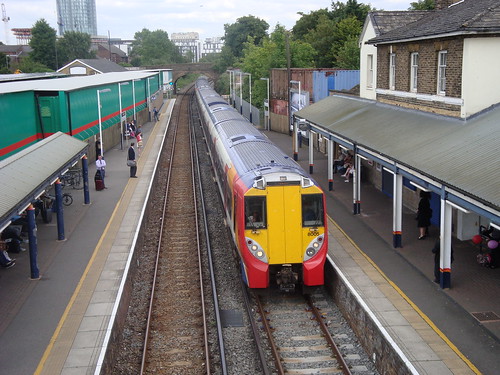
458005 heads a service to Reading diverted via the Hounslow Loop, seen at Brentford in this photo. Unit 458005 was introduced in 2000, entering service on 25th February 2000, running services to Alton. The class was intended to run on Waterloo-Reading/Alton and Ascot-Guildford services. Due to the problematic issues with the 458s, this unit was prepared to return to Porterbrook, the leasing company in 2006 after numerous extensions to service. These problems included, but were not limited to unit end gangways, software, air conditioning and other physical workings of the trains.
Re-introduced in early 2007, this unit since ran with DDA compliant modifications. The Class 458s were then confined to the Waterloo-Reading service, running 8 car services. This was until 2013-2015, when these units were to be lengthened to 5 car using ex-Gatwick Express Class 460s. New unit end corridors based on the Desiro corridors were also fitted, albeit can only be used on the Class 444/450 in emergencies along with Dellner couplers. After conversion, these units ran on Waterloo-Windsor/Weybridge via Hounslow/Hounslow Loop services, with Class 450s replacing those on Reading services. This allowed services to be increased to 10 car maximum. This unit now runs as 458505.
The initial plan was for Class 707s to replace these Class 458/5s on their current services, returning the 458/5s to the Waterloo-Reading services. However, with the First-MTR takeover, these units, along with all electric non-Desiro units, will be replaced by new Aventras.

It has been 21 years since South West Trains (Stagecoach) started running across the South West of London and England. As one of the first rail franchises to be tendered and privatised, this set a new precedent for the future. With the exception of the Island Line being added onto the franchise in 2007, there has been no operational change on the South Western franchise.
Stagecoach had invested in replacing all slam door units, and the first foray into the replacement for that was the Class 458, a very troublesome set of units built by Alstom in Washwood Heath, Birmingham. Later on came the Siemens Desiros (Class 450 and 444), which provided the rest of the slam-door replacement. Class 460s off Gatwick Express (replaced ironically by Class 442s off SWT) were used to lengthen the Class 458s to 5 coaches per unit, and were reclassified into Class 458/5s.  Class 456s came from Southern to lengthen services to 10 car and provide extra peak hour services in 2014. Finally, the last trains that SWT introduced in their franchise was the Class 707 Desiro City, introduced with limited service on Thursday 17th August 2017 just so they have entered service under SWT.

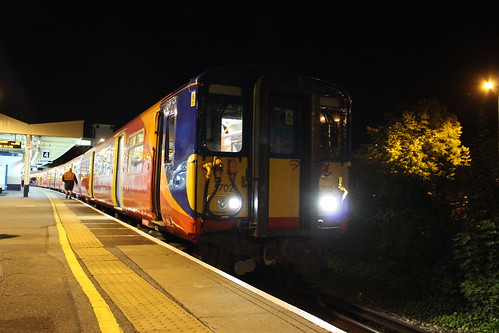
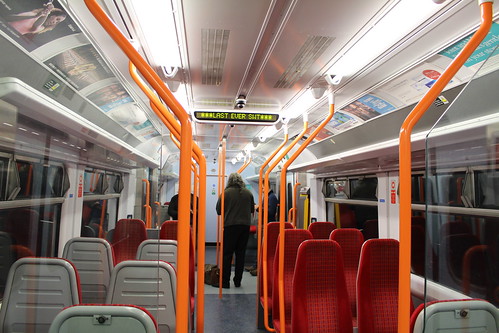
The last service for South West Trains ran in the early hours of the 20th August 2017, with the 0142 Waterloo-Surbiton service formed of 455702 and 455705. Running via East Putney, this service arrived as the last service at 0218 at Surbiton.

The Last SWT Service
The last SWT service at Surbiton, 455702/455705
(© Aubrey)

The Last SWT Service
**Last Ever SWT**
(© Aubrey)

From 20th August 2017, First-MTR operate the South Western franchise as South Western Railway.

20/07/2017

Picture Archive Post 61


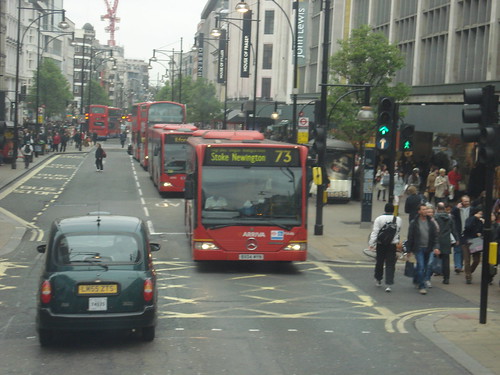
Arriva London MA46 on Route 73, Oxford Circus, 14/04/2011
Arriva London MA46 on Route 73, Oxford Circus, 14/04/2011 (© Aubrey)

Before Wrightbus brought out the New Routemaster, or as it's more colloquially known, the Borismaster, Ken Livingstone too had a way to reduce dwell times at bus stops. The same concept of boarding and alighting at any door kept the same. However, Ken Livingstone's way to do this was with buses that were from Germany, with Mercedes-Benz Citaro O530Gs. This particular example was acquired for the 73, when it was converted from AEC Routemasters to the colloquially known "bendy-bus". Based at then new Lea Valley Garage (LV), it served the 73 and the 149. It served on the 73 until 03/09/2011, when the route was converted to Volvo B5LH/Wright Eclipse Gemini 2 operation. That also removed all-door boarding from the route, but not the rarely used bus stop ticket machines in Central London. This example was then painted white and put into more ill-fated service. This time, this was at Arriva Malta, where it ran as BUS 702. By August 2013, however, these buses were forced off the road by the government of Malta, after multiple fires. These buses were then supposed to be sold to Sudan, but this has not materialised since.

Route 73 started out as a King's Cross-Barnes route in 1914. By 1934, the route ran to Stoke Newington and Richmond, based at Tottenham (AR) and Mortlake (M). Until 1988, Stoke Newington-Richmond was the base part of the route. During the 1930s and until 1945, extensions to Kingston (peak hours) and Hampton Court (Summer Sundays) were run. RTs and RTLs were introduced from 1949. From 1958, the route ran as a split route, replacing Route 27A on Sundays, then the Monday-Friday operation of Route 33. Thus, the route ran Hounslow-Kensington and Stoke Newington-Richmond, gaining a Hounslow (AV) allocation from 1958. The Hounslow-Kensington part was basically a renumbering of Route 33. From December 1962, the whole route gradually converted to Routemaster. In 1965, all non-AR/M allocations were withdrawn, and from 1966, the route was retracted from Hammersmith gradually, being replaced by the re-introduction of the 33, and the 281, thus by 1982, the route ran Hammersmith-Stoke Newington, with the route running from AR and Hammersmith (R). When Hammersmith (R) closed, the allocation there moved to Shepherd's Bush (S). From 1987, the Sunday service became OPO with MCW Metrobuses.

From 13th August 1988, the 73 was rerouted at Hyde Park Corner to Victoria, with new route 10 replacing the Hammersmith section. The Sunday service, then operated by Shepherd's Bush, moved to Stamford Hill (SF). Under sectorisation, the route moved to Leaside Buses, which was later purchased by the Cowie Group, eventually known as Arriva. From 1990, the Sunday service was extended to Stamford Hill, ending when the Stamford Hill allocation moved to Tottenham (AR). By this time, a service which was frequent but irregular at times ran to Tottenham Swan via Seven Sisters Station. When the route was converted to articulated buses on 4th September 2004, the irregular service was cut back to Seven Sisters Station. The route also moved to Lea Valley (LV) at this time.

As part of then Mayor Boris Johnson's commitment to withdraw articulated buses, the route was converted to hybrid operation on the 3rd September 2011, with Volvo B5LH/Wright Eclipse Gemini 2s. 73 was also cut back to Stoke Newington full-time, and re-allocated to Stamford Hill (SF). Borismasters then beckoned on the 73 from May 2015. The most recent route change happened just over a month ago, when the 73 was withdrawn between Oxford Circus and Victoria, replaced by Route 390. The 390 ironically was introduced from a split of the 10, made from the split of the 73.

20/06/2017

Picture Archive Post 60

London United VA74 on Route 120, Southall Station, 23/03/12
London United VA74 on Route 120, Southall Station, 23/03/12 (© Aubrey)

Route 120 moves to Metroline from the 24th June 2017, its second private operator after London United (under various owners of Transdev and RATP).

By 1934, the route ran from Hounslow Heath to Hayes, run from Hounslow and Southall Garages. In 1936, the route was shortened to a Southall-Hayes stub. Southall became the sole garage from 1938 when it was re-extended to Hounslow Heath. In 1951, the route was converted to RT. Under the trolleybus replacement program in 1960, the 207A replaced the 120 between Hayes and Southall. From 1965, the route was extended to Greenford. Between 1978 and 1979, the route was allocated DMSs (with one man operation), before switching to MCW Metrobuses From 1986, the 120 returned to Hounslow Garage. In 1987, Route 120 replaced Route 257 to Beavers Farm Estate by splitting the service to a yellow/black blind service southbound. Yellow blinds meant that the route went via Beavers Farm Estate and black blinds meant the route ran to Hounslow Bus Station. Southall-Greenford was withdrawn in 1988. In 1991, the route lost its Beavers Farm Estate loop to the new minibus H21.
However, in March 1993, the route was re-extended north of Southall, this time replacing the 232 to Northolt, as that route was being localised as the H32. January 1994 saw the route be fully converted to low-floor as one of the first routes to be converted. Dennis Lance SLF/Wright Pathfinder (LLW) buses were filled with passengers. That and unreliablility meant some MCW Metrobuses and other double decker buses from Hounslow strayed onto the route. From 2000, the route was converted to Volvo B7TL/ALX400 and President buses (VA/VP). Strays of Olympians arose when some transferred to Hounslow, and in general, the route became just another double decker route out of the night routes, 111, 120 and H32. After 2009, Scania N230UD/OmniCity buses started to stray onto the route, and SPs became the norm. Contract renewal in 2012 brought new Enviro 400s (ADE), which is where the route is at the moment.
From 24th June 2017, the route will gain Volvo B5LH/Wright Eclipse Gemini 3 buses from Metroline's Perivale West (PA) garage.

Volvo B7TL/Alexander ALX400 VA74 was a Hounslow machine, branded for Route 111 (oneeleven branding) initially. This branding wore out, and the bus was later repainted red with the grey skirt untouched when the 80% red rule became a skirt colour only rule. Between 27/09/12 and 26/10/12, the bus was based at Fulwell for a short time. Otherwise, throughout its life, it ran on the double decker Hounslow Garage routes. The bus became Hounslow's last Volvo B7TL/ALX400, with withdrawal on 4th November 2013.
This bus has since passed onto Whippet Coaches, where it still runs as WD416.

20/05/2017

Picture Archive Post 59

Wrong Blinds!
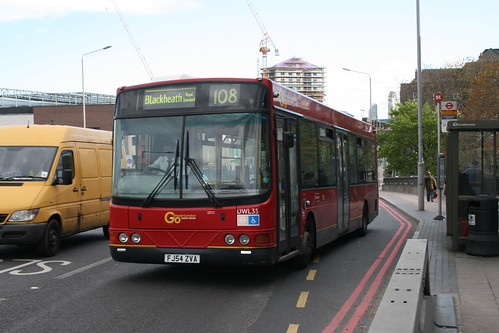
London Central DWL35 on Route 108, Bromley-by-Bow, 09/05/15 (© Aubrey)

A fairly recent photo for this month's Picture Archive, the VDL SB120 is not normally seen on London's streets. So when East Thames Buses (TfL in-house operator) ordered new buses to replace Excels for the 108, these (albeit badged as Volvo Merits) were the bus choice. Unfortunately, these were plagued by reliability problems, and eventually were withdrawn when sufficient Darts were available.

DWL35 started out as an East Thames Buses (TfL) bus operating the 108 and 132 from Belvedere (BV) in January 2005. In October 2009, due to the policy of Boris Johnson to withdraw the role of physical bus operation of TfL, the bus moved to Go-Ahead London (London General). East Thames Buses was only formed after the collapse of Harris Bus. These buses were allocated on the 108 for most of its life, moving with it to New Cross (NX) in May 2010. By the end of 2010, the buses were refurbished into full Go-Ahead livery. This lasted until 2015, when it went into brief storage at Bexleyheath (BX), being withdrawn in January 2017 after spending its final few days on the 225.

Route 108 itself started out as a route from Bromley By-Bow to Crystal Palace with double decker buses. Each double decker bus for the 108 at the time were especially modified for the route. The NSs had solid tyres and a rounded body with the roof curving further in, thus allowing it to fit in the tunnel, and scrub against the kerb within the tunnel. They were replaced by STLs which had steel reinforced pneumatic tyres and a special profiled roof. The reason for all these modifications for the buses was due to the Blackwall Tunnel. When the tunnel was lowered, normal buses appeared in 1954 and RTLs were the mainstay. In 1960,the route was withdrawn on weekdays Lower Sydenham-Crystal Palace. Poplar (Atholl Street) (C) closed, moving the route to Poplar (PR) in 1961. In 1967, the new southbound bore of the Blackwall Tunnel was opened, and it could fit deckers comfortably.
Then in 1968, the old, now northbound tunnel was raised again to widen the roadway. This meant the 108 was converted to single deckers (AEC Merlins), and thus was cut to run only between Bromley By-Bow and Blackheath. The route was extended to Eltham in 1970. AEC Swifts replaced the Merlins in 1973. In 1977, the route was extended to Stratford on Monday-Saturday, and on Sunday in 1978. 1978 also meant the unsuccessful Swifts were replaced by Leyland Nationals. In November 1985, Poplar (PR) closed, and the route moved to Bow (BW). In June 1986, the route was modified to Stratford-Lewisham. This state did not last long, and in 1988, due to the withdrawal of Route 10, the 108 was extended from Stratford to Wanstead.
Under sectorisation, the route passed to East London for only a few months, before tendering moved it to Boro'line Maidstone based in, erm... Maidstone. New Leyland Lynxs were ordered for the route, which stayed when Boro'line Maidstone realised there was not as much money in London as they'd think. Kentish Bus took over, and a more local base of Crayford (CR) was chosen. In September 1993, the route was shortened back to its 1986 state. Part of the allocation moved to Lewisham (LM) in 1994, along with new Volvo B6/Northern Counties buses. The Lewisham allocation lasted only between February and August 1994, as that section moved to Cambridge Heath (CH). Tendering moved the route back to Crayford but with Harris Bus in April 1997. New Optare Excels converted the route to low-floor.
Harris Bus themselves only lasted until March 2000, before TfL took over. A night service (as N108) was introduced in September 2001, before the N108 lost the N in November 2003. East Thames Buses got new Volvo Merits (re-badged DAF SB120s) in 2005 for the route. However, by then, the Optare Excels were so unreliable, ex-Limebourne Dennis Dart/Caetano Compass buses were drafted in to run the service. In 2010, the route moved to New Cross. 108N had a special escort arrangement when the tunnel was closed at night, but otherwise the route was either split or worked via Tower Bridge when the Blackwall Tunnel was closed.

On 1st October 2016, the route swapped ends with the D8 between Poplar and Stratford, thus allowing the D8 to go to empty double deckers. The 108 gained Mercedes-Benz Citaros from the electrification of Route 507 and 521, and thus the route finally now has full-sized buses:

London Central MEC3 on Route 108, Stratford City
London Central MEC3 on Route 108, Stratford City (© Aubrey)

20/04/2017

Picture Archive Post 58

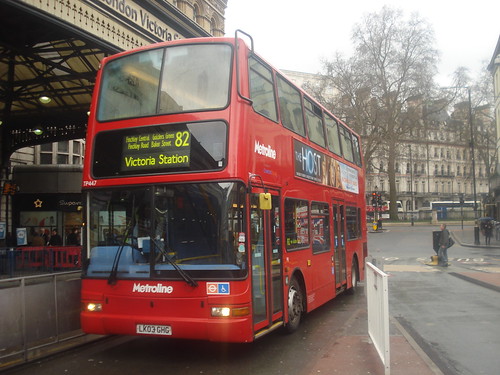
Metroline TP447 on Route 82, Victoria Station, 17/03/13
Metroline TP447 on Route 82, Victoria Station, 17/03/13 (© Aubrey)

Route 82 started out in 1986 as a route to replace Route 2B, running between Victoria and Golders Green, with garage journeys to North Finchley and the Sunday service going to Barnet, Chesterfield Road with MCW Metrobuses. Under sectorisation, Route 82 passed to London Northern, as it was at Finchley Garage. Leyland Titans were also introduced to the route. In February 1991, the Barnet journeys were cut to Golders Green. May 1991 saw the route being extended on Monday-Saturdays (except evenings) to North Finchley. The Sunday service was extended in November 1991, and the full service was extended to North Finchley in December 1993 as Finchley Garage closed. The route moved to Potters Bar, where it would stay until the route was withdrawn. London Northern then was bought out by MTL in 1994, and then Metroline in July 1998. New Volvo B7TL/Plaxton Presidents were bought onto the route in late 2001, before the allocated Trident/Plaxton Presidents arrived in 2002. These buses were replaced in March 2012 with ADL E40D/Enviro 400s.
The Enviros stayed allocated on the 82 before the route was withdrawn on the 31st March 2017, as part of the Finchley Road corridor cutbacks. Route 134 took those Enviro 400s, and the 82 was renumbered to 13. The "new" 13 is now run by Tower Transit using Volvo B5LH/MCV EvoSetis from Westbourne Park Garage.

TP447 was ordered for Routes 217, 231 and W8 back in 2003 at Potters Bar Garage. For most of its life, it has spent time on most Potters Bar routes. After withdrawal on January 2014, the bus passed to Watts Coaches in Wales, where it is still to this day.